Will your post work?
Paste your draft. We compare it to LinkedIn posts from a corpus measured one by one, and email you what, in your text, sounds like a machine rather than like you.
How it works
- Step 1
Paste your draft
The text you are about to publish, as is. Nothing to connect, nothing to install.
- Step 2
The scan compares it to the corpus
Your text is filed into measured buckets, then compared to real posts from the corpus.
- Step 3
Your analysis by email
Your score, the breakdown dimension by dimension, and the writing tics your post shares with a generated text.
Free LinkedIn post analyzer: will your post work?
The scan reads your draft before you publish it and compares it to 4,064 LinkedIn posts measured one by one, from 249 authors. It first looks for what gives away generated writing: three tics whose excess separates our own texts from those written by hand. Then it measures what your post's format is worth on the corpus. No language model is involved, the calculation is deterministic, and two scans of the same text give the same result. Free, no account, and your text is not kept.
By Maxence Vroilant, founder of Never Boring AIUpdated on .
The score compares your post to 4,064 LinkedIn posts measured one by one, not to an opinion about what works.
What the corpus says
The same numbers a scan uses. Some are counter-intuitive, and we do not smooth them out.
Try it
Post length makes no measurable difference
1,050 characters
−1% engagement
indistinguishable from chance
- under 400+2%, indistinguishable from chance
- 400 to 800+1%, indistinguishable from chance
- 800 to 1,400−1%, indistinguishable from chance
- 1,400 to 2,2000%, indistinguishable from chance
- over 2,200−4%, indistinguishable from chance
Measured on 1,573 posts in this band, from 228 authors. 95% interval: from −4% to +2%. It straddles the corpus median, so this gap cannot be told apart from chance.
None of the 5 bands stands clearly apart from the median. Length does not count toward the score.
What each media type changes
Only one format out of 5 stands clearly apart from the corpus median.
- Poll−73%39 posts
Clear gap, 95% interval from −82% to −45%
- Image0%2,087 posts
Indistinguishable from chance, 95% interval from −3% to +2%
- Text only0%1,122 posts
Indistinguishable from chance, 95% interval from −3% to +2%
- Video+2%458 posts
Indistinguishable from chance, 95% interval from −1% to +2%
- Carousel−2%358 posts
Indistinguishable from chance, 95% interval from −8% to +2%
The vertical line is the corpus median. The bar is the measured engagement gap, the thin line its 95% interval. When that line crosses the median, the gap cannot be told apart from chance.
What each way of closing a post changes
2 of these 6 closings stand clearly apart from the corpus median. A positive gap is not advice: the scan counts these closings, it does not recommend them all.
- No explicit ask at the close+2%2,714 posts
Clear gap, 95% interval from 0% to +2%
- Points to a link placed in a comment−16%171 posts
Clear gap, 95% interval from −28% to −3%
- A link placed directly in the post−3%716 posts
Indistinguishable from chance, 95% interval from −6% to +2%
- Ends on a question0%263 posts
Indistinguishable from chance, 95% interval from −7% to +6%
- Invites a direct message+2%103 posts
Indistinguishable from chance, 95% interval from −13% to +19%
- Asks people to comment a keyword−8%35 posts
Indistinguishable from chance, 95% interval from −50% to +16%
The vertical line is the corpus median. The bar is the measured engagement gap, the thin line its 95% interval. When that line crosses the median, the gap cannot be told apart from chance.
What the scan covers without an account
72% of the measured weight, across four dimensions.
- Post type13 %
- Substance7 %
- Hook7 %
- Call to action8 %
- Form5 %
- Media type59 %
- Character count0 %
In black, the dimensions scored here. Dotted, the ones that need an account.
How the score works
Four questions, and how we answer each one. Open the one you care about.
The scan does not read your text the way a reader does. It extracts observable properties: the character count, the length of the first line, whether there are blocks separated by an empty line, the median sentence length, how the post ends, the type of media attached to it.
Each of these properties files your post into a bucket. « First line under 60 characters » is a bucket. « Ends with an invitation to comment » is another. The corpus holds enough posts for each bucket to have its own measured performance: how many reactions and comments the posts falling into it get, on average.
Your score for a dimension is the performance of your bucket in that dimension. The overall score is the average of those scores, weighted by what each dimension actually separates.
A writing tic is not a mistake. It is a habit that comes back too often, and a habit can be changed in one line.
- 4,064
- posts measured
- 249
- auteurs
- 7
- dimensions
The seven dimensions, and what each one weighs
The weights are measured on the corpus, not chosen. They move as the corpus grows. Calibrated on October 14, 2026.
Media type
- What it looks at
- Image, carousel, video, or text only.
- Measured weight
- 59.0 %
- Evaluated here
- Yes
Post type
- What it looks at
- The family of the post: story, advice, stance, behind the scenes.
- Measured weight
- 13.3 %
- Evaluated here
- No, needs an account
Call to action
- What it looks at
- How the post closes: question, statement, invitation.
- Measured weight
- 8.1 %
- Evaluated here
- Yes
Substance
- What it looks at
- The topic covered and how the argument unfolds.
- Measured weight
- 7.4 %
- Evaluated here
- No, needs an account
Hook
- What it looks at
- The mechanics of the first line, the one that decides whether you read on.
- Measured weight
- 7.4 %
- Evaluated here
- No, needs an account
Form
- What it looks at
- The breakdown: airy blocks, sentence length, lists, first line.
- Measured weight
- 4.7 %
- Evaluated here
- Yes
Character count
- What it looks at
- The length bracket your post falls into.
- Measured weight
- 0.0 %
- Evaluated here
- Yes
| Dimension | What it looks at | Measured weight | Evaluated here |
|---|---|---|---|
| Media type | Image, carousel, video, or text only. | 59.0 % | Yes |
| Post type | The family of the post: story, advice, stance, behind the scenes. | 13.3 % | No, needs an account |
| Call to action | How the post closes: question, statement, invitation. | 8.1 % | Yes |
| Substance | The topic covered and how the argument unfolds. | 7.4 % | No, needs an account |
| Hook | The mechanics of the first line, the one that decides whether you read on. | 7.4 % | No, needs an account |
| Form | The breakdown: airy blocks, sentence length, lists, first line. | 4.7 % | Yes |
| Character count | The length bracket your post falls into. | 0.0 % | Yes |
What we get asked
the most
The questions that keep coming up about the scan, answered without rounding off.
Yes, and without an account. You paste your text, you give a first name and an email to open the result, that is all. There is no card and no limit to how many posts you can scan.
The method
Never Boring AI is an AI agent for LinkedIn, built by Maxence Vroilant. The corpus this scan uses as a reference is collected one post at a time, with its real counters, then cleaned: sponsored posts are set aside, company pages too, and lines whose counters could not be read reliably drop out of the measurement.
We publish what the corpus allows us to say, and we write down what it does not. A dimension that separates nothing does not enter the score. A pattern that does not hold on a held-out set is discarded. A number we do not measure, such as reach, is not shown. It is a smaller base than the ones advertised elsewhere, and that is a choice: we prefer a verifiable number to a large unverifiable one.
Your first 5 posts are on us
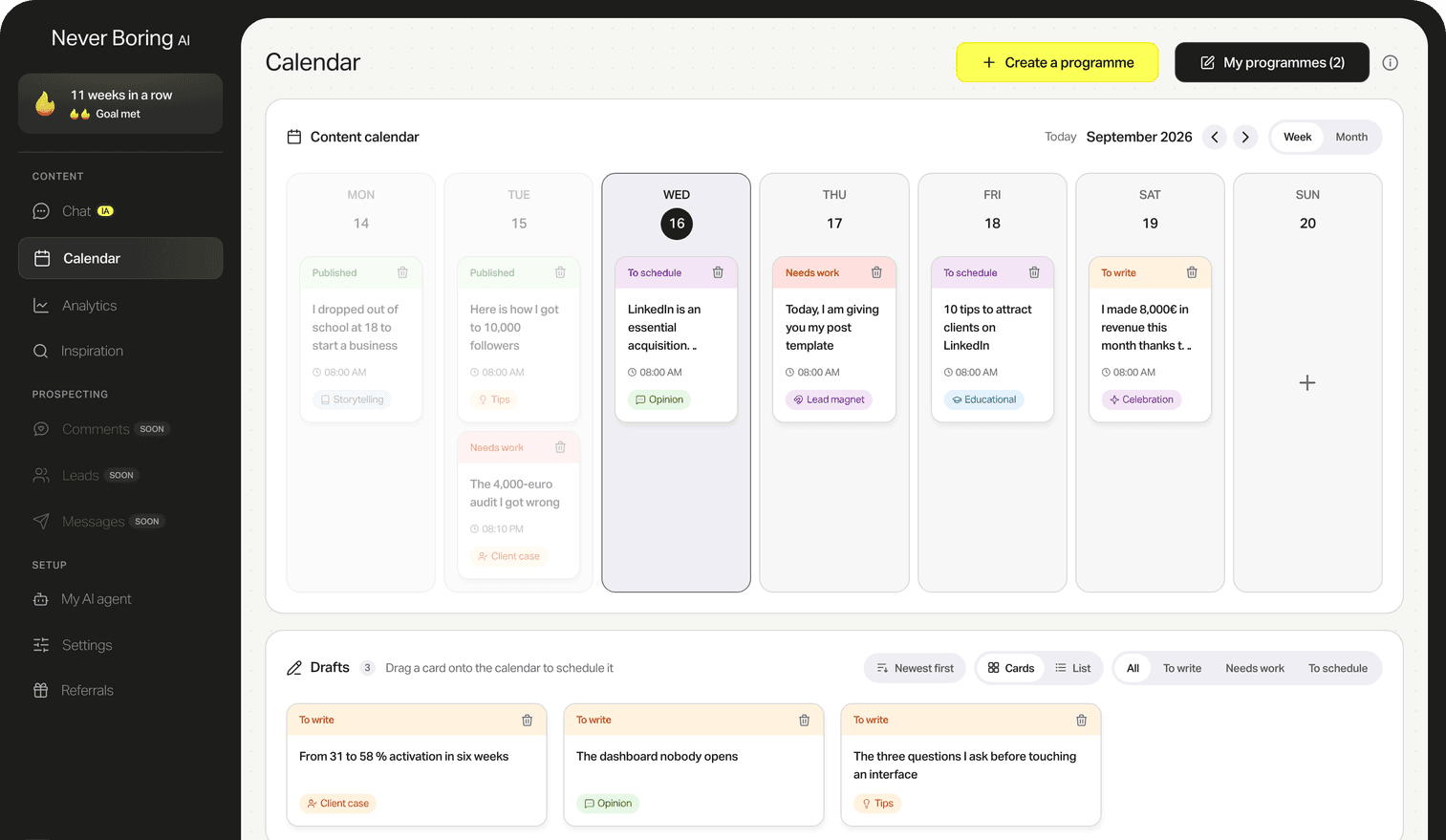
Create your account, no credit card needed, and walk away with your first post in minutes. Your LinkedIn calendar then runs on its own.


Already used by
232 founders