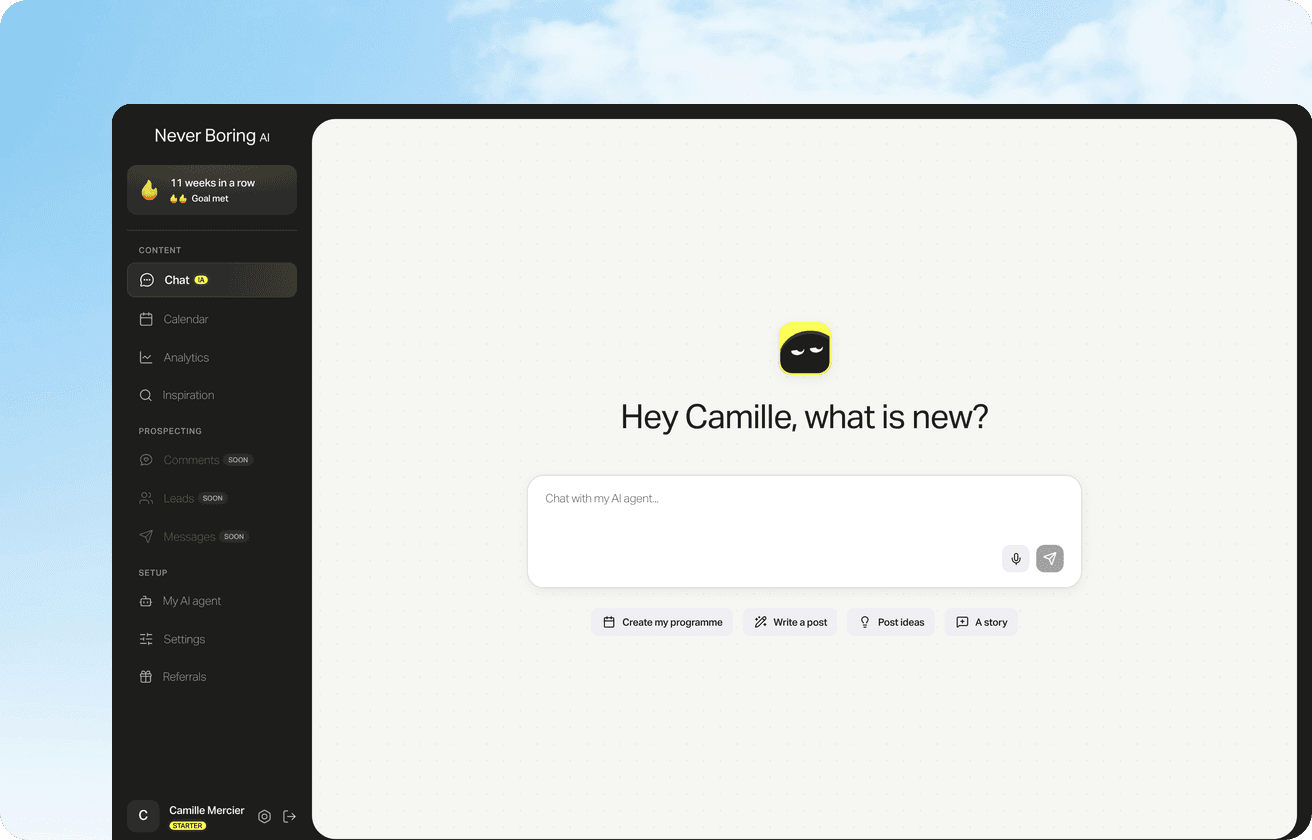
You tell it about your week, it keeps what matters: your stories, your numbers, your convictions. The more you talk to it, the less your posts look like everyone else's.
It reacts, then asks the next question: the exact moment, the number, what changed. That is where the material comes from, the kind no generator can invent.
The story bank
What you live does not get lost
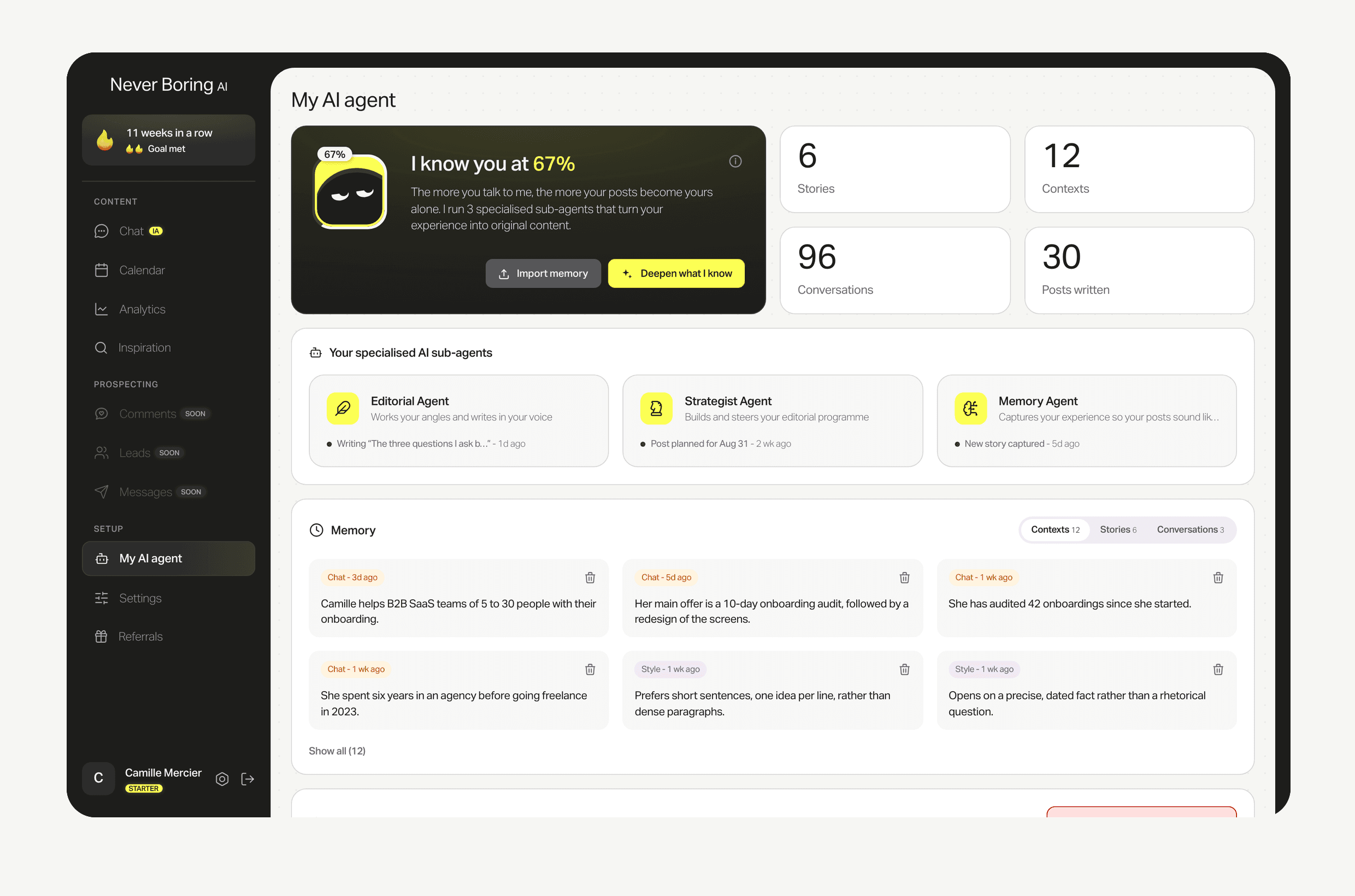
Every story is filed, readable and editable. You can correct it or have it forgotten, and nothing is reused without appearing here.
Three sub-agents
Each with its job, one shared memory
They hand over to each other and all work from what you told them.
Editorial agent
It works your angles and writes in your voice.
Strategy agent
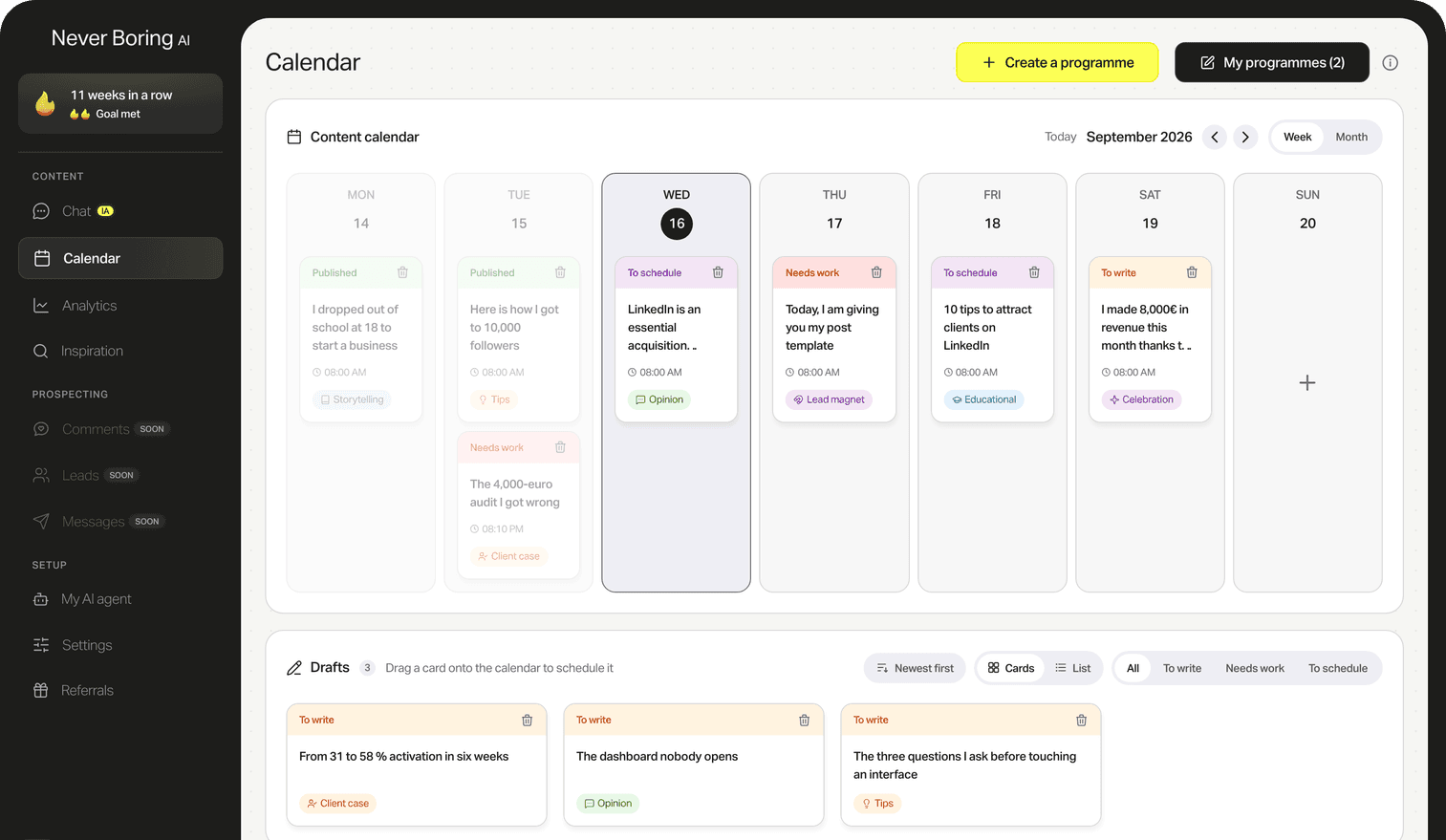
It builds your calendar and places your posts on the dates.
Memory agent
It picks up what you live as you talk and files it for later.
The method
How to give an AI what it needs to write like you
An AI writes like everyone else as long as it knows nothing about you. What changes everything is the material: your stories, your numbers, your convictions. The model matters less than what you feed it. Here is how to pass that material to your agent without spending your evenings on it.
1
Describe your work and your audience
Start with the foundation: what you sell, to whom, and the problem you solve. These lasting facts serve every post, and they stop the agent from giving you an offer or a client base that is not yours. A few lines are enough at the start. They get sharper over your conversations, and you can correct them at any time from the My AI agent page. Be concrete rather than flattering: “small manufacturing firms with 20 to 200 staff” gives the agent far more to work with than “ambitious businesses”.
The foundation
Freelance developer, I help small manufacturing firms replace their spreadsheets with internal tools.
2
Tell it about your week, not your CV
The best material is recent: a conversation with a client, a hard decision, a project that went off the rails. Just answer the agent's questions. It reacts, then digs where a story gets interesting: the exact moment, the number, what changed afterwards. You can also talk to it by voice, or give it a text you have already written. A short session at the end of the week, while things are still fresh, tends to produce more usable stories than a long one once a month.
What it asks
You say the project nearly fell through. At what exact moment, and what saved it?
3
File every story
A story told once should serve several times. The Memory agent files it in your story bank, with its context, so the Editorial and Strategy agents can use it later. You read it, fix it if a detail is wrong, or remove it: nothing is reused without appearing in that list. It is worth a quick look after each conversation, because a wrong number caught now is a wrong number that never reaches a published post.
Filed story
Rebuilt a manufacturer's quoting tool: three days a month saved for the sales team.
4
Correct what sounds wrong
Your voice is also learned from your corrections. When you edit a generated post, the agent draws a writing rule from it and applies it to the next ones: a turn of phrase you delete every time eventually stops coming back. The more you correct at the start, the less you correct later, and the further your posts drift from everyone else's. Small edits count too: changing one word you would never use teaches as much as rewriting a paragraph.
Learned rule
Never start a post with a question.
The pitfalls
What stops an AI from writing like you
The problem rarely comes from the model. It comes from what you give it, or from what you forget to give it. These four habits explain most of the posts that come out flat.
Giving it a theme instead of a fact
Avoid
Write a post about project management.
Instead
Write about the project delivered late in March, and the meeting where I said no to the client.
A theme lets the AI fill in with generalities, and the result looks like everything that already exists. A dated fact, with something at stake, leaves it only one way to write: yours. That is why your agent asks questions before drafting. If you only have a theme in mind, ask yourself when it last cost you or a client something: that moment is the fact to start from.
Starting from scratch every conversation
Avoid
Pasting your context back in at the start of every new chat.
Instead
An agent that keeps your work, your audience and your stories from one time to the next.
An assistant without memory makes you repeat who you are, and forgets the details that made the difference. A lasting memory, visible and editable, builds value instead: every conversation makes the next posts more accurate. It also means the stories you told three months ago are still there when a calendar needs one, without you having to remember them.
Keeping stale memories
Avoid
An old offer showing up in your posts six months after you dropped it.
Instead
A memory you reread now and then, where you fix what has changed.
A memory is only useful if it is accurate. Your rates change, your audience shifts, a client no longer wants to be named. Reread your lasting facts when your business moves, and delete what should no longer be used: it takes a minute. A good moment to do it is whenever you update your own website or your rates: if the offer changed there, it should change in your agent's memory too.
Publishing what does not sound like you
Avoid
Accepting a post that sounds off, telling yourself it will do.
Instead
One sentence to say what is wrong: too long, too smooth, not your words.
A post published as is when it sounds off costs you twice: your audience feels it, and the agent learns nothing. Say what you would change, in one sentence. Your memory stays yours: it only feeds your own posts and trains no model. The more precise the feedback, the faster the next posts improve: “too formal” helps, “I never say leverage” helps even more.
Rated 5/5 by its users
245 founders have already trusted Never Boring.
Translated from French.
Jonah ZehaniBrand, web and product designer
First off, congratulations Maxence. The work you did solo, and above all the quality of the app's design. That is something. Well done. (...)
Looking forward to seeing NeverBoring grow
FLFlorenceNever Boring AI user
A very efficient and relevant agent: barely any time spent setting it up. Quality posts with different angles. There are always a few tweaks left to match my style, and then it is good to go!
Louis MontagneFounder and CEO, ICONOKOM
Very cool so far, inteliigent post writing
GUGuillaumeNever Boring AI user
Great tool, smart agent!
An innovation in writing!
Will MariWeb designer
Super easy to use
Jonah ZehaniBrand, web and product designer
First off, congratulations Maxence. The work you did solo, and above all the quality of the app's design. That is something. Well done. (...)
Looking forward to seeing NeverBoring grow
Louis MontagneFounder and CEO, ICONOKOM
Very cool so far, inteliigent post writing
FLFlorenceNever Boring AI user
A very efficient and relevant agent: barely any time spent setting it up. Quality posts with different angles. There are always a few tweaks left to match my style, and then it is good to go!
Will MariWeb designer
Super easy to use
GUGuillaumeNever Boring AI user
Great tool, smart agent!
An innovation in writing!
GUGuillaumeNever Boring AI user
Great tool, smart agent!
An innovation in writing!
Will MariWeb designer
Super easy to use
Jonah ZehaniBrand, web and product designer
First off, congratulations Maxence. The work you did solo, and above all the quality of the app's design. That is something. Well done. (...)
Looking forward to seeing NeverBoring grow
FLFlorenceNever Boring AI user
A very efficient and relevant agent: barely any time spent setting it up. Quality posts with different angles. There are always a few tweaks left to match my style, and then it is good to go!
Louis MontagneFounder and CEO, ICONOKOM
Very cool so far, inteliigent post writing
FLFlorenceNever Boring AI user
A very efficient and relevant agent: barely any time spent setting it up. Quality posts with different angles. There are always a few tweaks left to match my style, and then it is good to go!
GUGuillaumeNever Boring AI user
Great tool, smart agent!
An innovation in writing!
Louis MontagneFounder and CEO, ICONOKOM
Very cool so far, inteliigent post writing
Will MariWeb designer
Super easy to use
Jonah ZehaniBrand, web and product designer
First off, congratulations Maxence. The work you did solo, and above all the quality of the app's design. That is something. Well done. (...)
Looking forward to seeing NeverBoring grow
FLFlorenceNever Boring AI user
A very efficient and relevant agent: barely any time spent setting it up. Quality posts with different angles. There are always a few tweaks left to match my style, and then it is good to go!
GUGuillaumeNever Boring AI user
Great tool, smart agent!
An innovation in writing!
Louis MontagneFounder and CEO, ICONOKOM
Very cool so far, inteliigent post writing
Will MariWeb designer
Super easy to use
Jonah ZehaniBrand, web and product designer
First off, congratulations Maxence. The work you did solo, and above all the quality of the app's design. That is something. Well done. (...)
Looking forward to seeing NeverBoring grow
A question before you start?
The questions that keep coming up about ai agent and memory, and how we answer them.
Two distinct things. Stories, meaning precise moments you tell it about. And lasting facts about you: your work, your offer, your audience, your convictions. Both are visible, editable and deletable from the My AI agent page.
By answering it, plainly. It asks about your week and digs when a story interests it. You can also dictate by voice, or import a text you already wrote so it can pull your context out of it in one go.
Yes, entirely. Each memory can be deleted one by one, and a button in your settings clears the memory and the conversation history in one gesture, without touching your posts.
Never. Your memory only feeds your own posts. It trains no model, serves no one else, and is neither sold nor shared.
100 on Starter, 300 on Creator. That is well beyond normal use: most accounts get through their month on one conversation a week.
Your first content plan and your first 3 posts are on us
Create your account, no credit card needed, and walk away with your first post in minutes. Your LinkedIn calendar then runs on its own.