LinkedIn AI ghostwriter: posts that sound like you
A LinkedIn ghostwriter writes your posts for you, under your name, in the way you talk. It can be a person, an agency or an AI. An AI ghostwriter does the job well on one condition: it has to know what to say and how you would say it. Without that raw material, it writes everybody's post, and your network can tell by the first line. If you are a solo founder, freelancer or consultant and LinkedIn always comes after client work, this one is for you. We look at what a ghostwriter actually does, what an AI can pick up from your voice, and what 1,165 real posts reveal about how differently people write.
What is a LinkedIn ghostwriter?
A LinkedIn ghostwriter is a writer who drafts posts for someone else, published under that person's name. Readers only ever see one author: you. The job comes down to three moves. Listen: a call, voice notes, a message thread where you walk through your week. Sort: find the one story in all of that which speaks to your audience. Write like you: your words, your rhythm, your verbal habits, even the ones you no longer notice. That third move is the hard one. Anyone can write a clean post about sales outreach. Writing yours, the one your clients would recognize without seeing your profile picture, means knowing you. That is exactly where a human ghostwriter, an agency and an AI start to differ.
Human ghostwriter, agency or AI: which one fits you?
A human ghostwriter is a freelance writer who works with a handful of clients and learns their voice over time. The upside: they ask the right questions and can tell when a story holds up. The downside: their calendar. You book calls, review drafts, wait for the next version, and the monthly fee works like any recurring contractor. An agency wraps a team around the writer: strategy, visuals, a publishing schedule. It suits executives who want to hand off their whole LinkedIn presence and have the budget for it. A general-purpose chatbot sits at the other end: fast and cheap, but it knows nothing about your business unless you keep explaining it, and the posts tend to sound like everyone else's. An AI ghostwriter is a tool built for this job: it drafts your posts from what you tell it and keeps that context between sessions. It answers instantly, never gets tired of your favorite topic, and costs a subscription. Its limit mirrors the human one: it only knows what you have told it. For a solo founder posting on their own, AI is often the only realistic ghostwriter. So the real question becomes: how do you hand it your voice?
An AI ghostwriter that starts from your experience
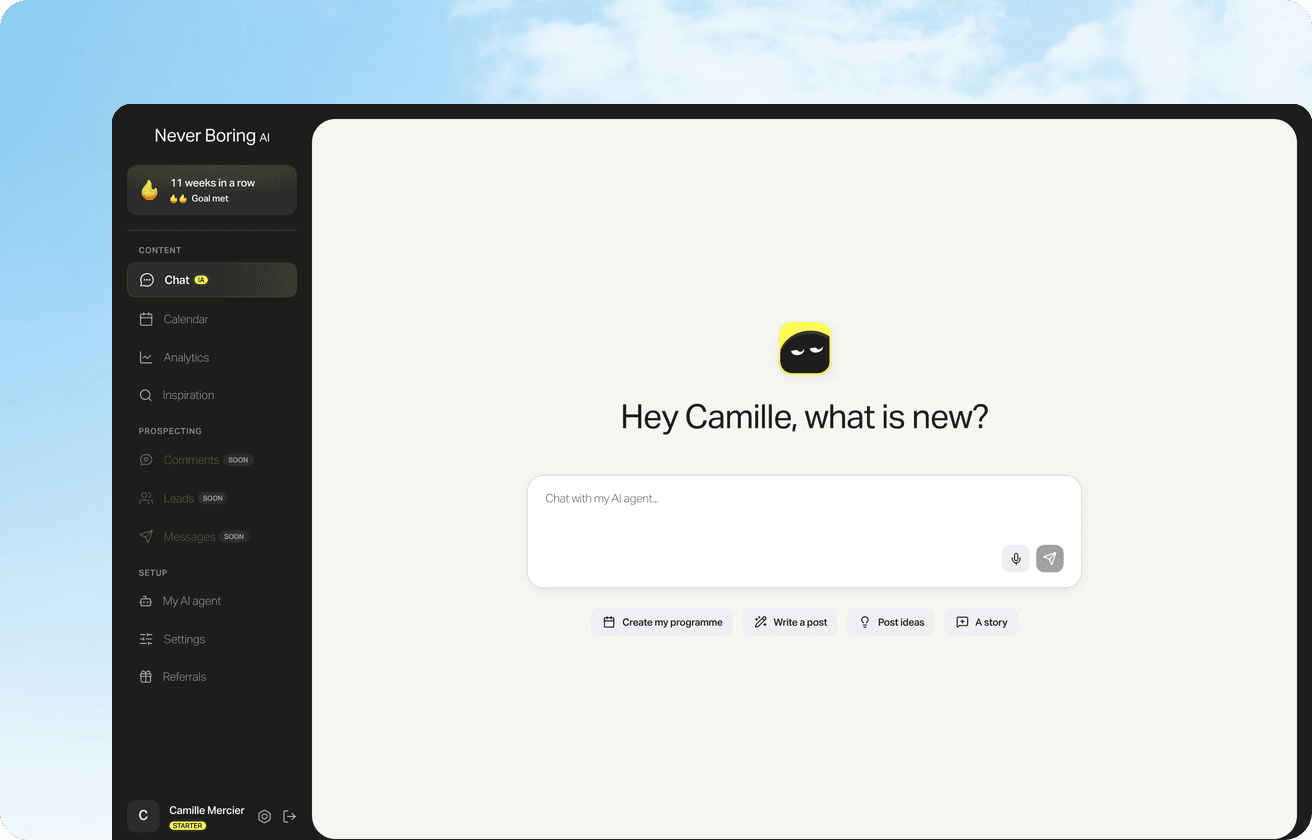
Never Boring AI is an AI agent for LinkedIn: it asks you questions, remembers your stories, builds your posting plan and drafts each post in your voice.
What makes your voice recognizable on LinkedIn?
Your LinkedIn voice is the set of writing choices that make a post sound like you: length, first line, the stories you tell, emojis or none. And those choices vary a lot from one author to the next. The Never Boring AI corpus shows it clearly. It holds 1,165 real, anonymized French-language LinkedIn posts written by 45 authors between March 20, 2025 and October 3, 2026. In that corpus, half of the posts run between 860 and 1,708 characters, around a median of 1,268. First lines vary even more: half of them run between 56 and 269 characters. Some authors open with one blunt sentence, others with a full paragraph. Same spread in how posts open. 40% of the hooks in the corpus start from a number, 34% from a strong statement, 14% from a contrarian take, 7% from an anecdote, and fewer than 4% from a question. Close to half of the posts are stories. As for emojis, 42% of posts have none, and the median is a single emoji per post. These numbers describe what gets published by this group of French-speaking creators. They do not say what performs best, and they do not cover all of LinkedIn, or English-language posts. They do say one useful thing: there is no single right format to copy. A ghostwriter, human or AI, who applies the same recipe to everyone erases exactly what sets you apart.
How does an AI ghostwriter learn to write like you?
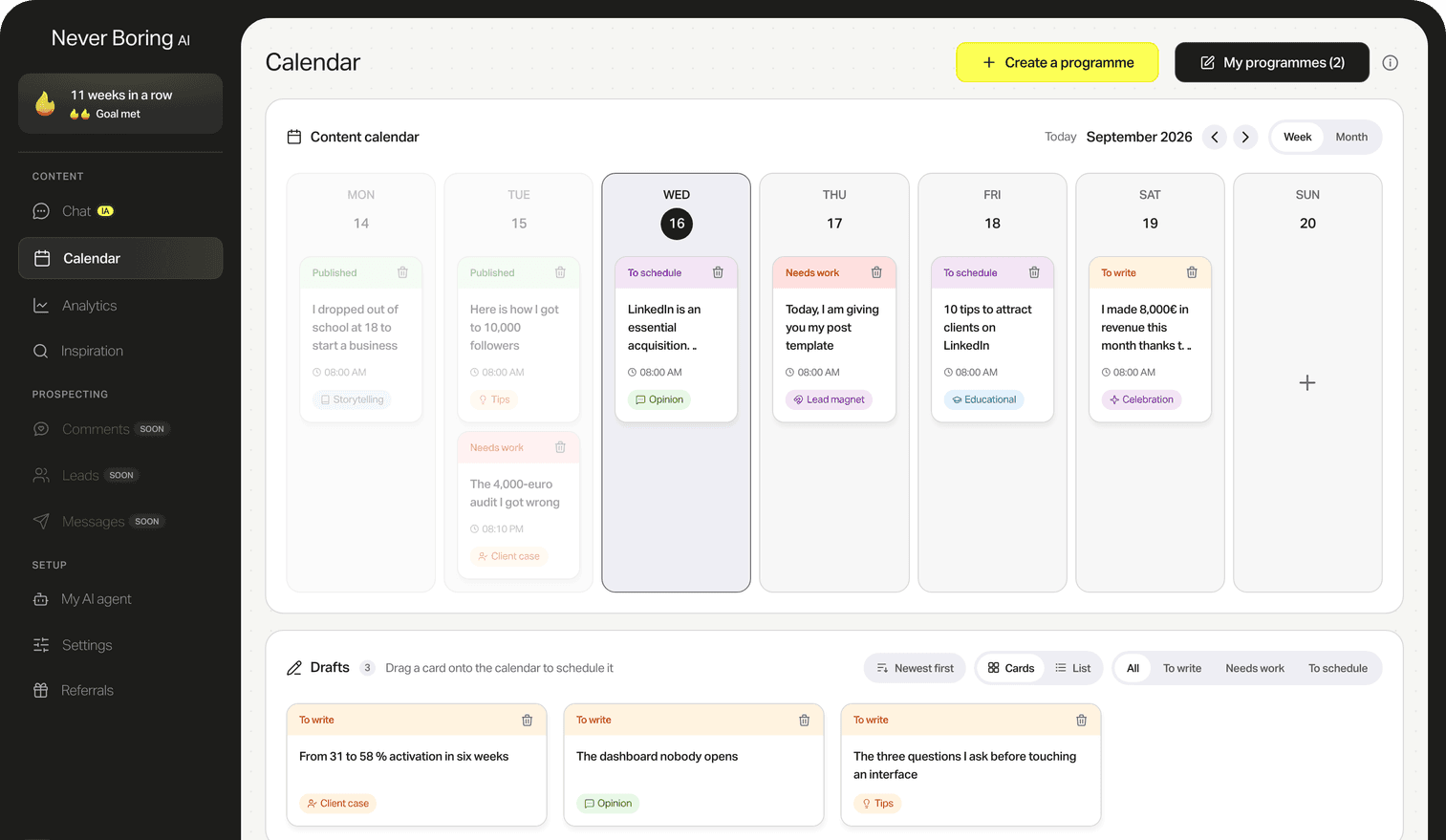
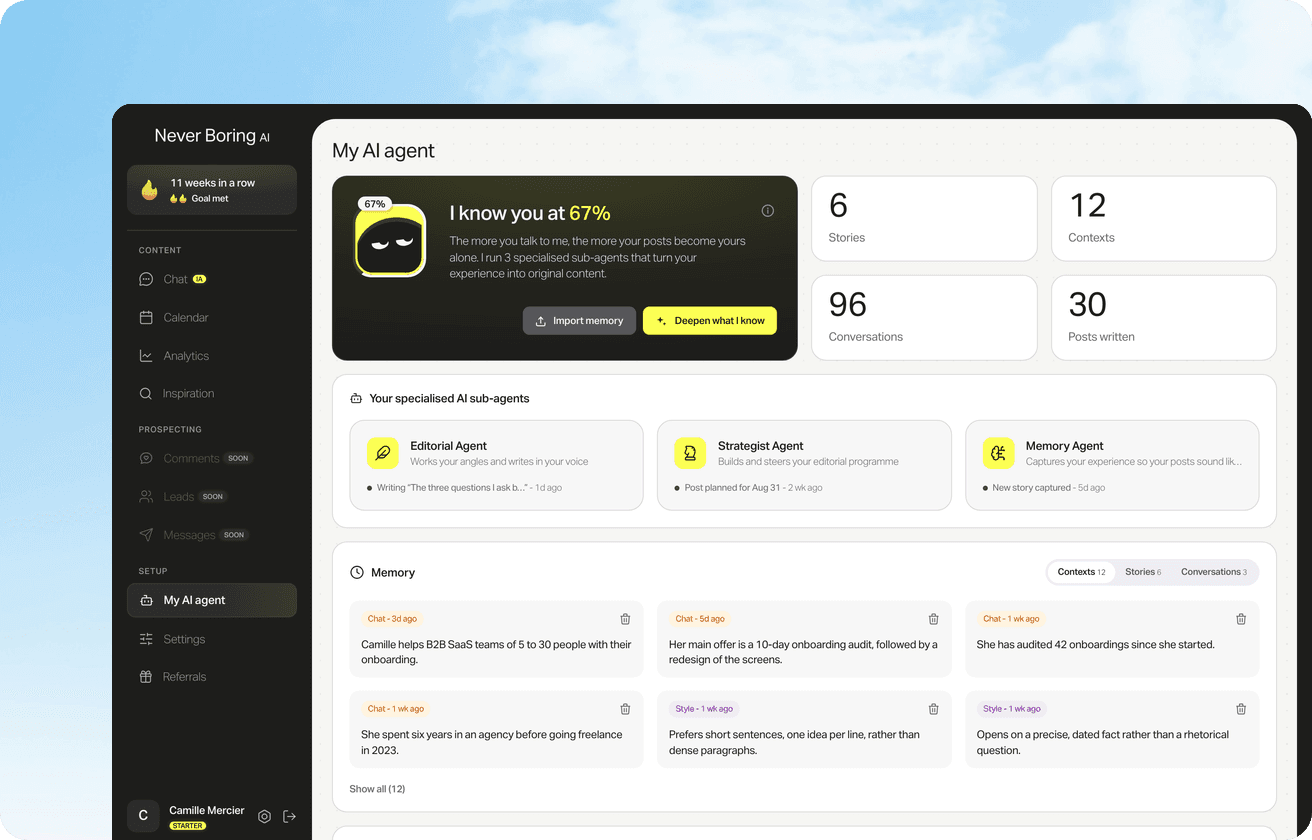
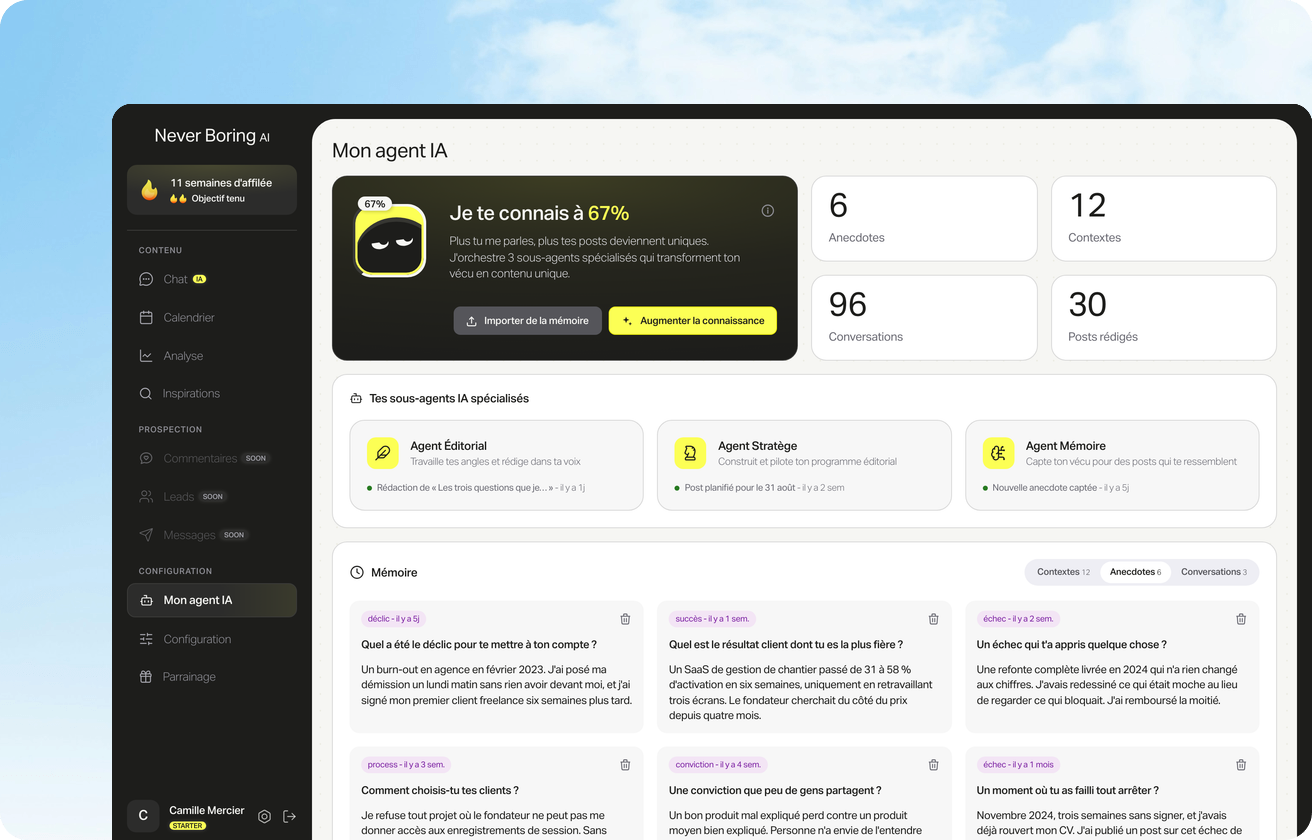
An AI ghostwriter learns your voice through three channels: what you tell it, what you have already written, and what you correct. No model guesses it for you. Take Never Boring AI, the tool built by the author of this blog. Three sub-agents share the work from a single memory. The Memory agent picks up your experience as you talk and files it in a bank of stories you can read, edit or clear. The Strategist agent builds your posting plan and places posts on the calendar. The Editorial agent drafts each post in your voice, from what you have shared. The conversation matters more than the prompt. The agent reacts to what you say, then digs where a story gets interesting: the exact moment, the number, what changed afterwards. That is where the material no generator can make up comes from. Your edits do the rest. When you change a generated post, the agent turns that edit into a writing rule and applies it to the next ones. A phrase you delete every time eventually stops showing up. You can also hand it your past posts, which it uses to write like you.
What should you feed your AI ghostwriter?
Your AI ghostwriter's raw material is the set of facts you give it before asking for a post: your job, your audience, your stories. The more specific it is, the less the post looks like everyone else's. Start with the foundation, in a few lines: what you sell, to whom, and the problem you solve. Those lasting facts stop the AI from inventing an offer or a client base that is not yours. Then tell it about your week, not your resume. The best material is recent: a client conversation, a tough call, a project that went sideways. Finally, give it facts, never topics. Compare these two requests: "Write a post about project management." "Write about the project we shipped late in March, and the meeting where I told the client no." The first one lets the AI fill the page with generic advice. The second leaves it only one way to write: yours. Take Mike, a made-up fractional CMO. If he asks for "a post about marketing budgets", he gets ten tips everyone has read. If he tells the story of the client who cut his budget in half and doubled his leads, the post can only come from him.
Generate LinkedIn posts with an AI that knows you
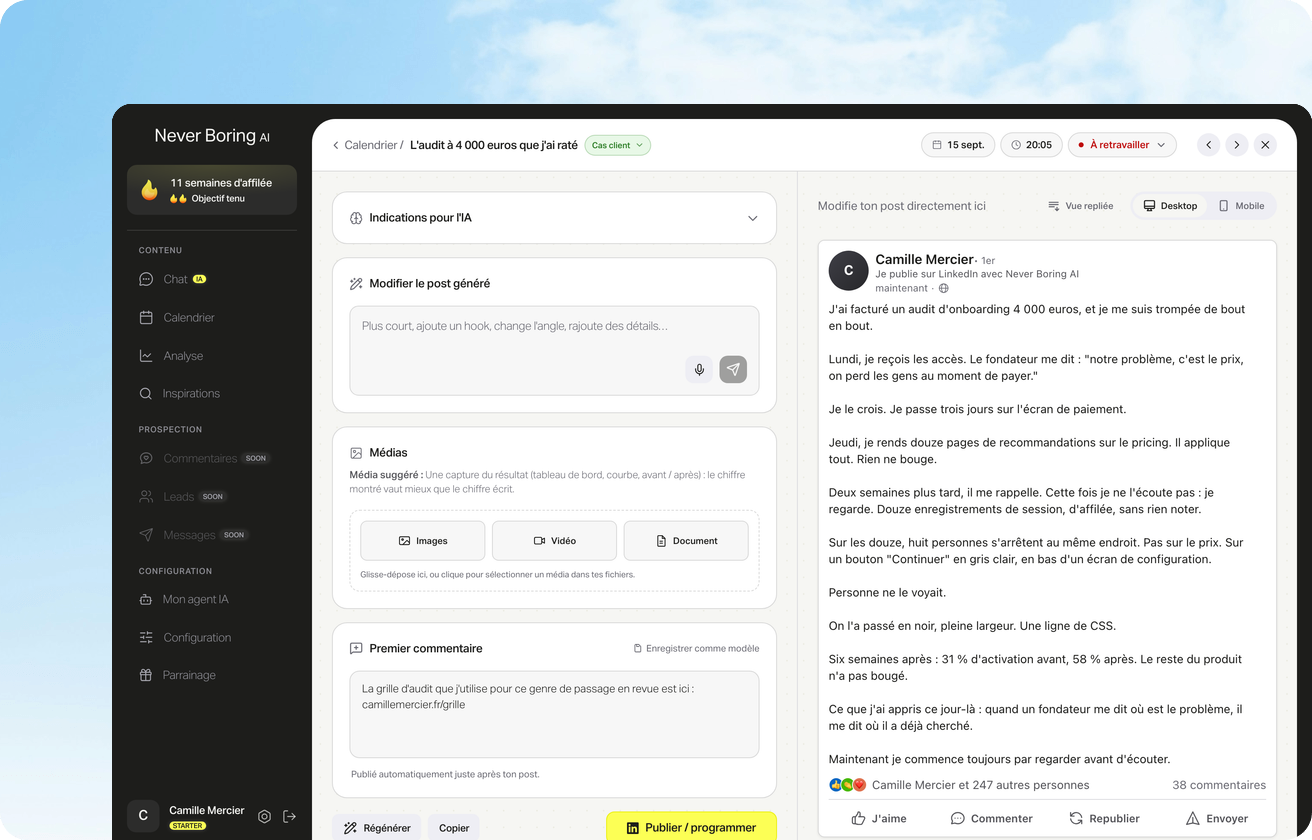
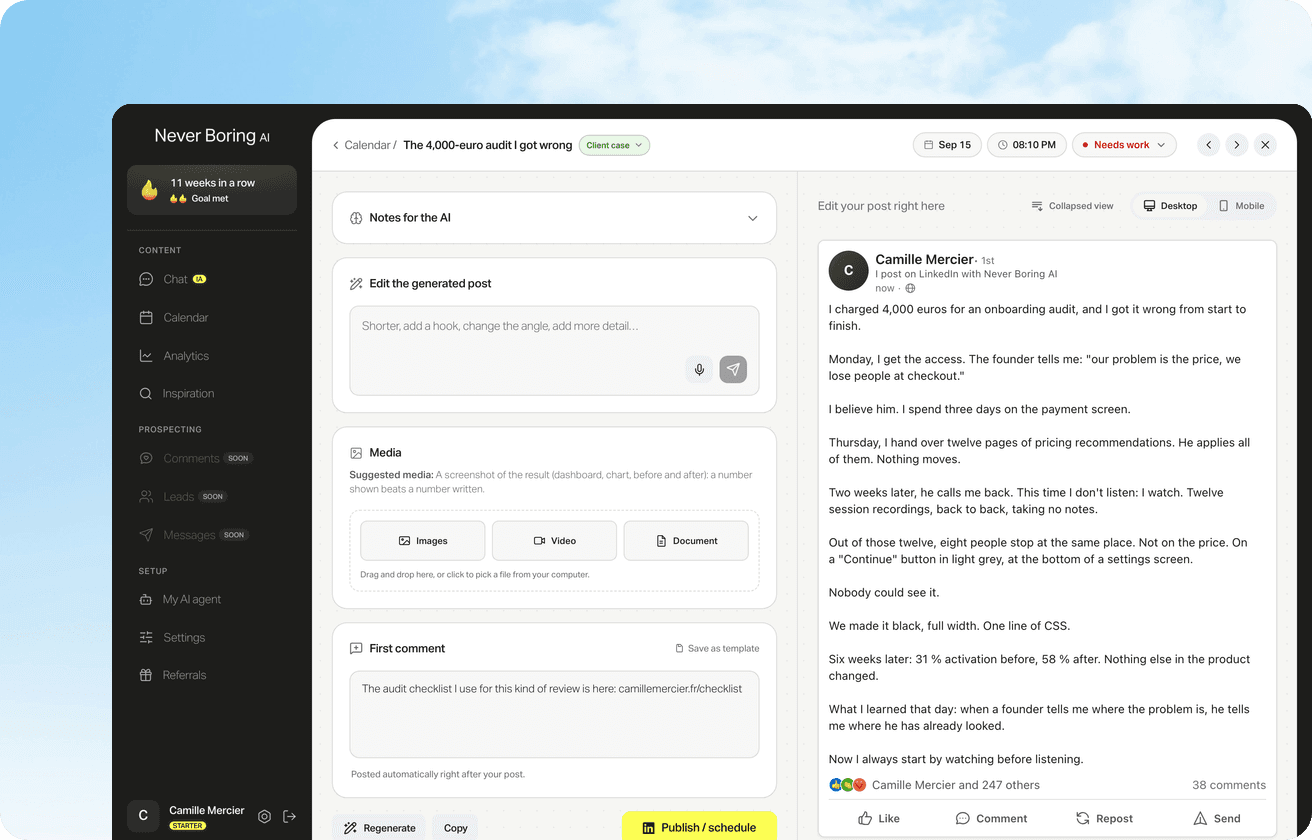
The Never Boring AI LinkedIn post generator starts from what you have shared, shows the post the way LinkedIn will display it, and rewrites it from a one-line instruction.
How do you spot a post that sounds like AI?
A post that sounds like AI is one where the writing habits show before the substance. Your readers are not running a test: they get a feeling of having read it before, and they scroll. A few signals come up again and again. The announcement opener, like "I'm thrilled to announce". Back-to-back contrasts, where every idea is first denied and then asserted. Several lines in a row that start with the same word. The lesson introduced by a label and a colon. And above all, no dated, numbered or named detail anywhere. One of these on its own proves nothing: plenty of human writers use them. It is the pile-up that makes a text feel manufactured. Reading your post out loud is still the simplest test. If you would never say a sentence to a client, it has no place in your post. To go faster, the Never Boring AI writing tics detector counts these habits in your text and compares them with handwritten LinkedIn posts. It does not tell you whether an AI wrote the text, which no tool can honestly claim: it shows what is overused, line by line.
Does your post sound like AI?
Paste your post into the AI writing tics detector: free, no account or email, instant result.
Is it okay to use an AI ghostwriter on LinkedIn?
Yes, as long as you stay the author. Using an AI ghostwriter is the same deal as working with a human one: someone helps with the writing, you own what gets published. A few things matter. Every fact has to be yours. The post goes out under your name, so every number, story and opinion must be real. An AI that fills a gap with a plausible scene puts you at risk. In Never Boring AI, the agent tells you when it infers a number or a context instead of making up a scene, but the final read is on you. What people dislike is generic content, not help with writing. Readers scroll past posts that could have been written by anyone. A post with your client, your numbers and your Tuesday afternoon does not trigger that reaction, whoever typed it. Keep the material fresh. An AI fed one onboarding interview will eventually go in circles, like the friend who tells the same joke at every dinner. Make a short weekly chat a habit to keep new stories coming. Disclosure is your call. Some creators say they get writing help, others do not, exactly as with human ghostwriters.
What should you remember before handing your posts to an AI?
A LinkedIn ghostwriter, human or AI, is only as good as the material you give it. The 1,165 French-language posts in the Never Boring AI corpus show very different lengths, hooks and styles from one author to the next: your voice is not a template to copy. For a solo founder, an AI ghostwriter is the easiest option to keep up over time, as long as you give it three things: a foundation about your work and your audience, recent facts rather than topics, and your edits. You review, you keep the final say, and your posts stay yours. Never Boring AI handles the whole loop: it builds your posting plan from your offer, your audience and your content pillars, drafts each post in your voice, then schedules it on LinkedIn.
Your first post in a few minutes
Tell the agent about your week and it turns it into your first post. Free trial, no credit card.
What questions come up most often?
The questions that keep coming up on this topic, and how we answer them.
Yes, as long as you stay the author. An AI ghostwriter plays the same role as a human one: it helps with the writing, and you own what gets published. Make sure every fact, number and story in the post is real and yours, review each draft before it goes out, and keep feeding the tool recent material so the posts do not drift into generic advice.
Read next
Your first 5 posts are on us
Create your account, no credit card needed, and walk away with your first post in minutes. Your LinkedIn calendar then runs on its own.


Already used by
237 founders