LinkedIn Premium cost in 2026: every plan and price
LinkedIn Premium costs between $39.99 and $99.99 a month depending on the plan, based on the starting prices LinkedIn publishes in October 2026. Premium Career is built for job seekers, Premium Business for growing your network, All-in-One and Company Page for small businesses. Sales Navigator, the prospecting tool, starts at $119.99 a month. Paying yearly cuts the bill, by as much as half for Career. If you are a freelancer, consultant or solo founder wondering whether to pull out the credit card, here is the spoiler: the right plan depends less on its price than on what you actually do on LinkedIn.
💸 How much does LinkedIn Premium cost in 2026?
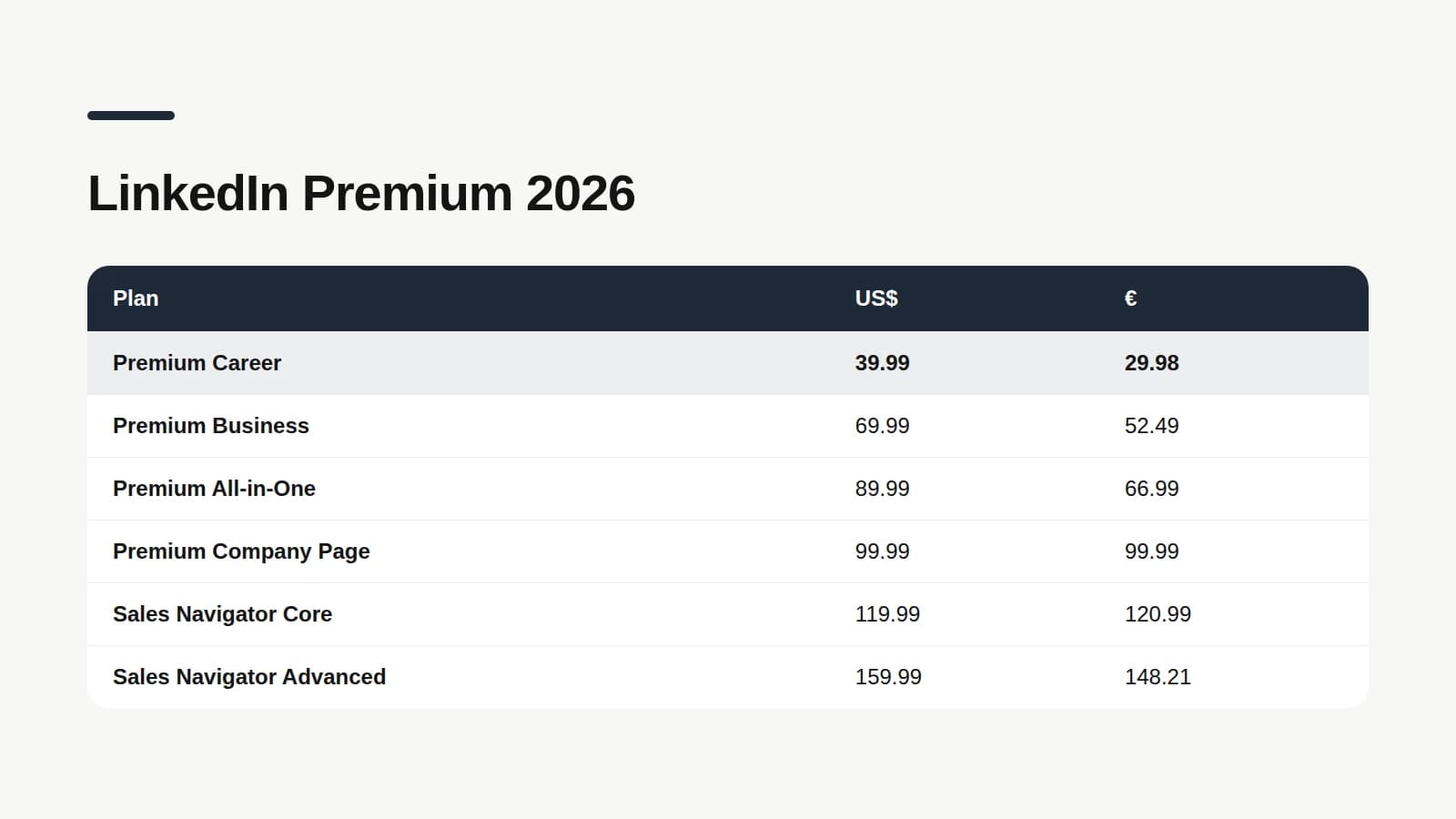
LinkedIn Premium is LinkedIn's family of paid subscriptions. Each one adds to the free account some InMail credits, search filters, profile insights and, depending on the plan, LinkedIn Learning. So there is no single price, there is a price per plan. Here are the starting prices LinkedIn lists in US dollars on its official pages (premium.linkedin.com and business.linkedin.com), checked on October 22, 2026: Premium Career: $39.99 a month, or $239.88 a year Premium Business: $69.99 a month, or $539.88 a year Premium All-in-One: $89.99 a month, or $899.88 a year Premium Company Page: $99.99 a month, or $839.88 a year Sales Navigator Core: $119.99 a month, or $1,079.88 a year Sales Navigator Advanced: $159.99 a month, or $1,799.88 a year Sales Navigator Advanced Plus and Recruiter Lite: no public price (custom quote or trial) One footnote, and LinkedIn wrote it: these are estimates. They may exclude sales tax or VAT and promotional discounts, and they can vary slightly by device. You see the exact price at checkout, once signed in. The Premium pages say their pricing was last updated on April 20, 2026. Bottom line: budget roughly $40 to $100 a month for a Premium plan, and $120 or more once Sales Navigator enters the picture. Annual billing changes the math a lot, more on that below.

Premium or not, the post still needs writing
Never Boring AI is an AI LinkedIn post generator that goes beyond generating: an agent that builds your posting plan from your offer and your audience, then drafts each post in your voice.
Premium Career: price and features for job seekers
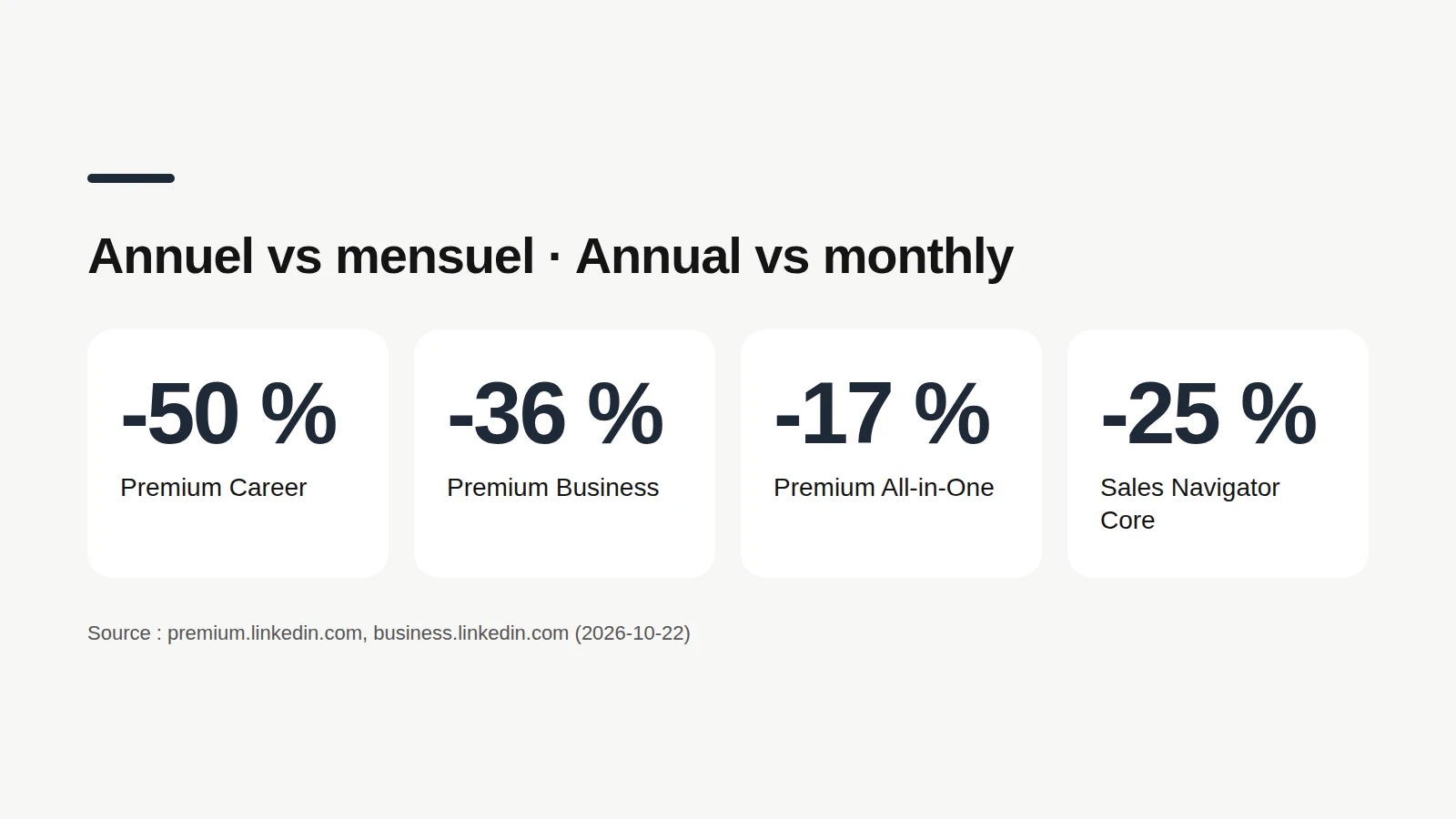
Premium Career is the LinkedIn plan built for people looking for a job or planning their next career move. It is the cheapest plan in the lineup. It starts at $39.99 a month, or $239.88 a year, which works out to $19.99 a month on annual billing. LinkedIn advertises a 50% saving for paying yearly. There is also a Duo option: two Career licenses on one subscription, from $59.98 a month or $359.88 a year. What LinkedIn puts in it, according to its official page: 5 InMail credits a month to message recruiters outside your network, the list of who viewed your profile over the past 365 days, private browsing, advanced job search filters, top applicant job matches, profile writing tips, a message proofreader and access to more than 25,000 LinkedIn Learning courses. If you freelance and have zero interest in a salaried job, a good chunk of that will be about as useful as a tie on a Zoom call. Career makes sense during a job hunt, far less when you are hunting for clients.
Premium Business: price and features for growing your network
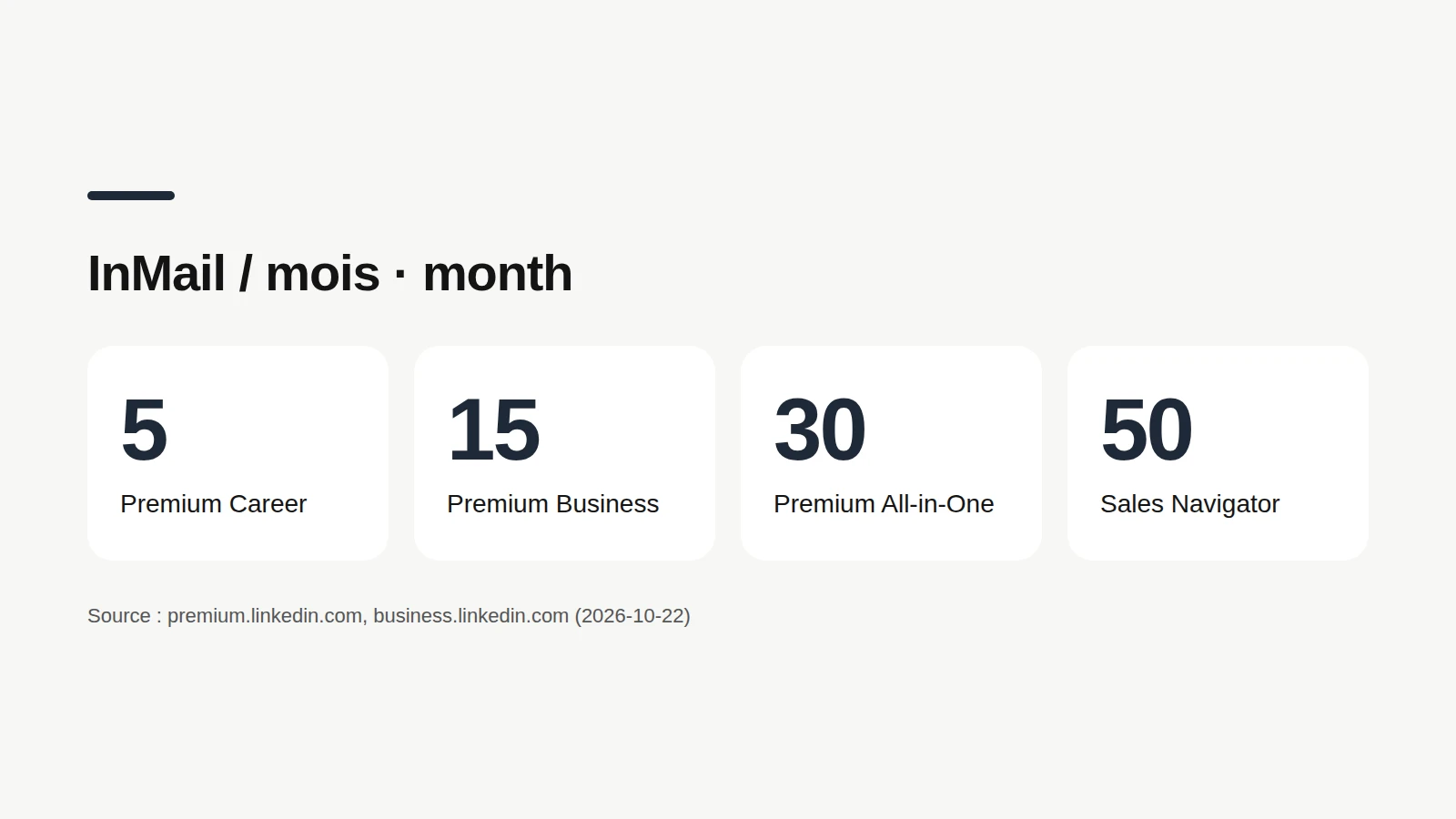
Premium Business is the LinkedIn plan for professionals and small business leaders who want to grow their network and build credibility. It is often the one freelancers look at first. It starts at $69.99 a month, or $539.88 a year, which is $44.99 a month on annual billing. LinkedIn advertises a 36% saving for paying yearly. The Duo option starts at $118.98 a month for two licenses. On the menu, according to the official page: 15 InMail credits a month, unlimited people and company search, the list of who viewed your profile, a custom call-to-action button on your profile, up to 5 images at the top of your profile, AI-powered profile suggestions, company insights (growth, hiring) and LinkedIn Learning. LinkedIn backs InMail with a number: based on its own March 2026 data, InMail gets 5.7 times more replies than cold email. That is LinkedIn measuring its own users, not a promise for your industry. Fifteen messages a month works for a handful of targeted introductions, not for a prospecting campaign.
Premium All-in-One and Company Page: the small business plans
Premium All-in-One is the LinkedIn plan that bundles sales, marketing and hiring tools for small business owners. It used to be called Premium Business Suite. It starts at $89.99 a month, or $899.88 a year, which is $74.99 a month on annual billing. LinkedIn advertises a 17% saving for paying yearly. It includes 15 daily prospect suggestions based on your criteria, 30 InMail credits a month, a dashboard with recommended actions, and ad credits: a paying subscriber gets $50 a month to boost posts and $50 a month for job posts, while annual subscribers get $600 of each up front. One detail matters: LinkedIn says the plan is still rolling out and currently available to a limited group, so you may not see it yet. Premium Company Page is not bought for a profile but for a company page. It starts at $99.99 a month, or $839.88 a year. It adds automatic follow invites for people who engage with your page's content, a custom call-to-action button, featured customer testimonials and competitor insights. If you mostly post from your personal profile, like most solo founders, this one is not for you.
How much do Sales Navigator and Recruiter Lite cost?
Sales Navigator is LinkedIn's sales prospecting tool, sold separately from the Premium lineup. It is built for people whose job is to find and contact prospects every day. There are three tiers, according to the official comparison page: Core: $119.99 a month, or $1,079.88 a year (about $89.99 a month) Advanced: $159.99 a month, or $1,799.88 a year (about $149.99 a month) Advanced Plus: custom pricing, based on team size and CRM integration All three include 50 InMail credits a month. LinkedIn advertises a 25% saving on Core and 6% on Advanced for annual billing. Cancellation takes effect at the end of the paid period: the end of the year for an annual plan, the end of the month for a monthly one. Recruiter Lite is the hiring tool for people who recruit a few times a year. It comes with 30 InMail credits a month. The official page invites you to try it for $0 but does not show a subscription price: you have to sign in to see it. If you are a solo founder who is not hiring, you can skip this one.
How much is LinkedIn Premium in the UK, Ireland, Canada and Australia?
LinkedIn doesn't publish prices by country, it publishes them by currency, and each one is a starting price. That's why two articles, or two coworkers, rarely quote exactly the same number. Here are the monthly starting prices LinkedIn lists in other currencies, checked on October 22, 2026: UK: £29.99 for Career, £49.99 for Business, £64.00 for All-in-One, £94.99 for Sales Navigator Core Canada: C$49.99 for Career, C$74.99 for Business, C$94.99 for All-in-One, C$144.99 for Sales Navigator Core Australia: A$54.99 for Career, A$74.99 for Business, A$94.99 for All-in-One, A$154.99 for Sales Navigator Core Euro: €29.98 for Career, €52.49 for Business, €66.99 for All-in-One, €120.99 for Sales Navigator Core There is no separate Irish price list. Ireland uses the euro, so the euro estimates are the closest public reference. Notice that the gaps are not a simple currency conversion: Career costs $39.99 but €29.98. Three more reasons the number moves, all spelled out by LinkedIn: taxes may not be included in the estimates, promotions aren't reflected in public prices, and prices can vary slightly by device. One case worth knowing: if you subscribed through Apple's App Store, LinkedIn's help center says you manage and cancel it from your Apple device. Before paying, compare the desktop price (signed in) with the app price.
Free LinkedIn vs Premium: what actually changes
LinkedIn's free account, called Basic, is the core access that lets you build a profile, engage with your network and post. Premium adds tools on top of it, it doesn't replace anything. LinkedIn sums up the difference itself: the free account is for engaging with your network, Premium adds advanced features such as company or applicant insights, who viewed your profile, profile writing help or a custom button. What the four Premium plans describe, in short: search, reach out, stand out, learn. What none of those official pages highlight, as of October 22, 2026: a posting plan or a content calendar. Yet for a solo founder, visibility is mostly built through what you post. And posting is free. The Never Boring AI corpus gives a sense of scale. It holds 1,165 real, anonymized French-language LinkedIn posts written by 45 authors between March 20, 2025 and October 3, 2026. Half of those posts get between 18 and 101 reactions, around a median of 40, and between 4 and 28 comments. The corpus doesn't say which authors pay for Premium, so it measures no effect of the subscription on those numbers, and it doesn't cover English-language posts. It only describes what posts that any account can publish collect in reactions.
🎁 How can you try LinkedIn Premium for free?
The LinkedIn Premium free trial is a period of free access to paid features, offered to eligible members. It comes with rules, and they are written in LinkedIn's official help center. Not everyone qualifies. If you already redeemed a Premium trial in the last 12 months, you are not eligible just yet, according to premium.linkedin.com. Trial length varies by region and current promotions. You need a valid credit card to start it. And during the trial, you can't switch between Premium plans for free. The classic trap: when the trial ends, it turns into a paid subscription automatically unless you cancel first. LinkedIn's help center says to cancel at least one day before your next billing date. On the flip side, canceling a trial ends it right away and you lose Premium access immediately. Canceling a paid plan keeps Premium active until the end of the billing cycle you already paid for. Common-sense tip: the day you start the trial, set a reminder two days before it ends. Your bank statement will thank you.
Is LinkedIn Premium worth it for freelancers and solo founders?
Whether LinkedIn Premium is worth it comes down to what the subscription brings you compared with what it costs, and that depends entirely on how you use LinkedIn. Four situations, four answers. You are job hunting: Premium Career is built for you, at least while the search lasts. At $19.99 a month on annual billing, it is the most affordable plan. You regularly reach out to people outside your network, and you want to know who looks at your profile: Premium Business gives you 15 InMails a month and unlimited search. Run the simple math: how many useful new conversations a month would make $69.99 feel well spent? Prospecting is your main job, every day: Sales Navigator is the tool built for that, with a matching budget, starting at $119.99 a month. Your lever is what you post: the free account is enough to post, comment and engage. Your budget is better spent on writing time, or on a tool that helps you keep a steady rhythm. Before paying for anything, at least look at your profile through a stranger's eyes.
Before Premium, a free audit of your profile
What a stranger sees when they land on your profile, and how your voice comes across in your recent posts: a free LinkedIn profile audit, no account needed.
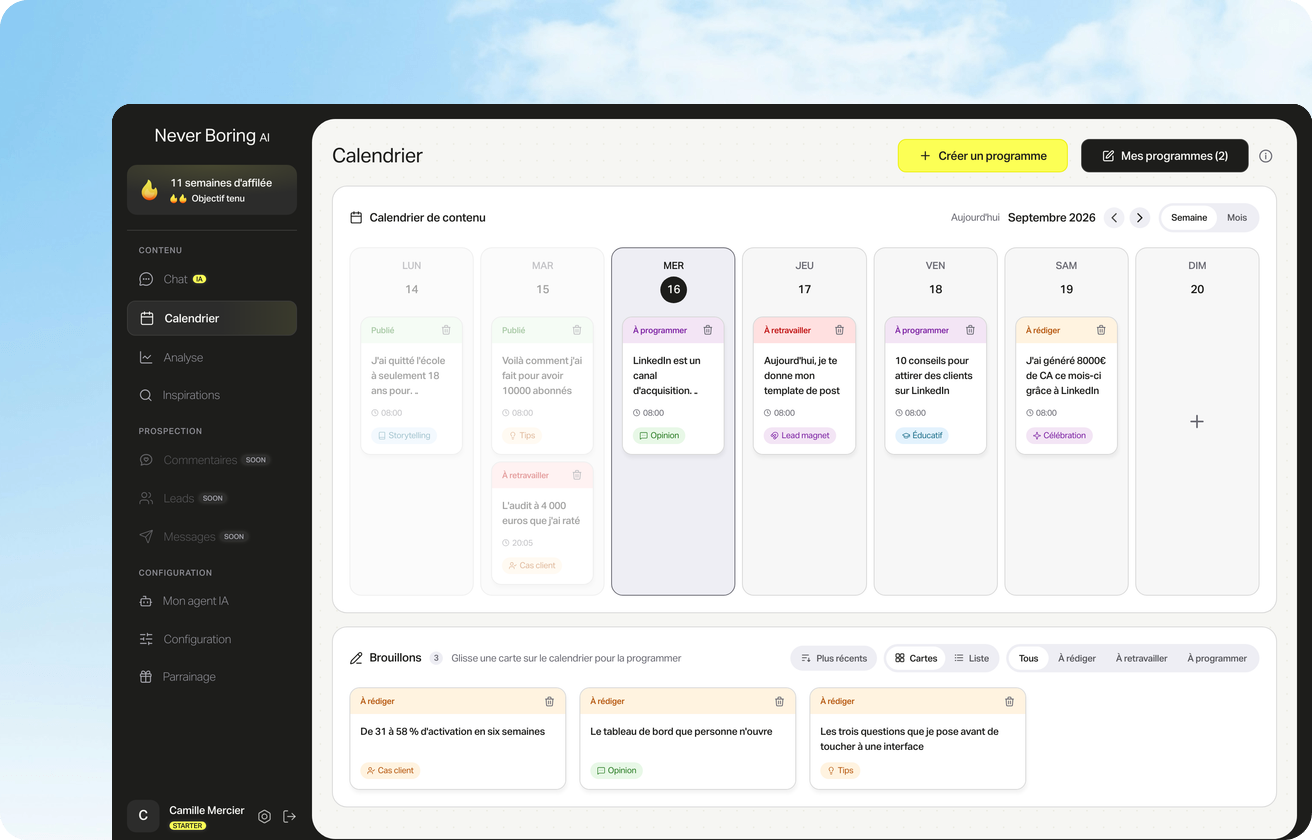
One last point that often gets left out of the math: InMail is not the only way to start a conversation. Leaving thoughtful comments on posts from people you'd like to meet is free, visible to their network, and uses no credits. It is slower than a direct message, but it doesn't feel like a sales pitch. That is what Never Boring AI supports on the comment side: you pick the profiles that matter to you, their new posts arrive every day with a comment suggested in your voice, and you review and approve. On the post side, the agent builds a content plan from your offer, your audience and your content pillars, and tells you what to post and when.
Comment on the right profiles, every day
Pick the profiles that matter for your business: their new posts arrive with a comment suggested in your voice, for you to review and approve.
Bottom line: which LinkedIn plan should you pick?
Picking a LinkedIn plan really means picking a use case. In October 2026, LinkedIn's published starting prices run from $39.99 a month for Premium Career to $99.99 for Premium Company Page, and from $119.99 to $159.99 for Sales Navigator, taxes possibly excluded. Career for job hunting. Business for a few targeted introductions and seeing who views your profile. All-in-One for small businesses that want to prospect, boost posts and hire, if it is offered to you. Company Page for a company page. Sales Navigator if prospecting is your daily job. And the free account if your main lever is what you post. Either way, pay yearly if you know you will keep the plan, and set a reminder before a trial ends. Premium opens doors, but no subscription writes your posts for you. That is what Never Boring AI is for.
Your posting plan, no blank page
Tell the agent about your business: it builds your plan, drafts your posts in your voice and schedules them on LinkedIn. Free trial, no credit card.
What questions come up most often?
The questions that keep coming up on this topic, and how we answer them.
Between $39.99 and $99.99 a month depending on the plan, based on the US starting prices LinkedIn published in October 2026: $39.99 for Premium Career, $69.99 for Premium Business, $89.99 for Premium All-in-One and $99.99 for Premium Company Page. Paying yearly lowers the monthly cost, to $19.99 for Career. LinkedIn notes these are estimates that may exclude taxes, so check the price at checkout.
Read next
Your first 5 posts are on us
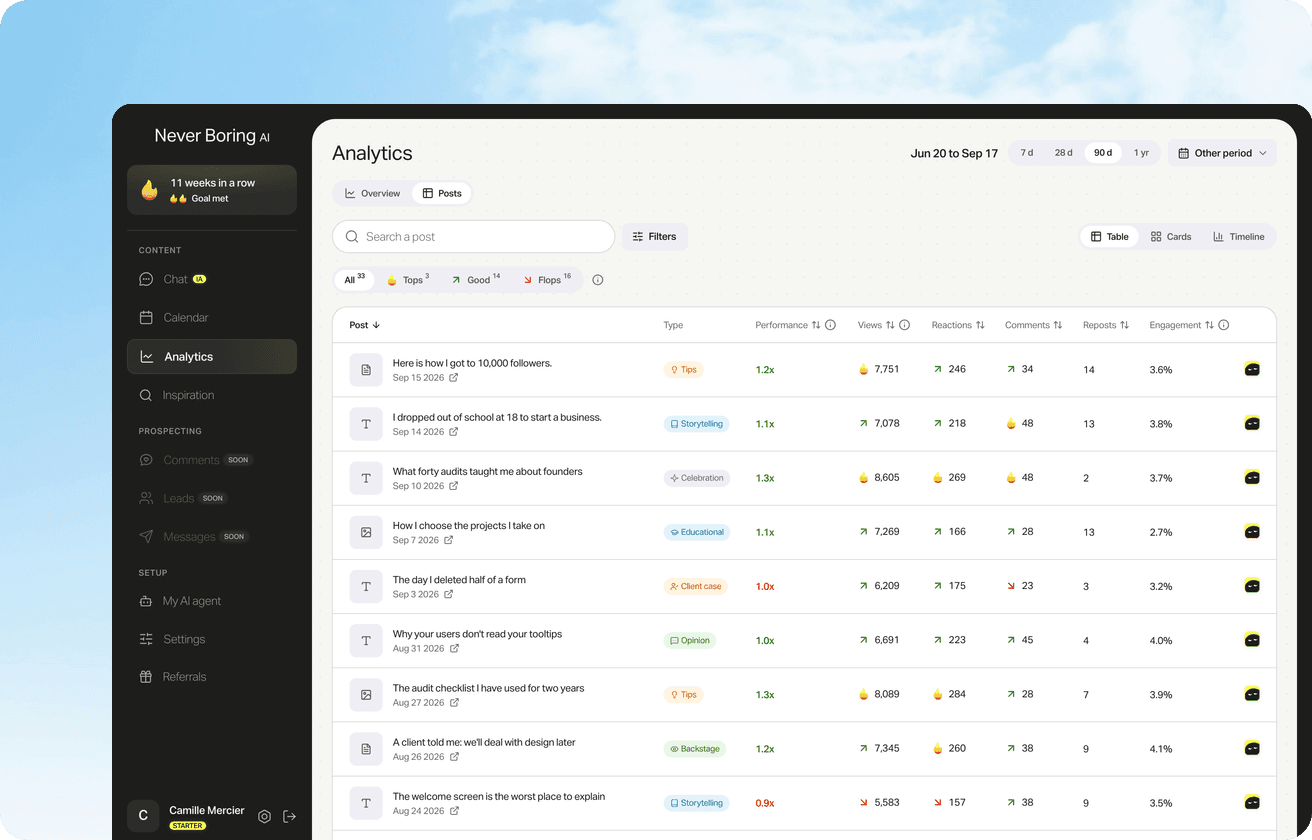
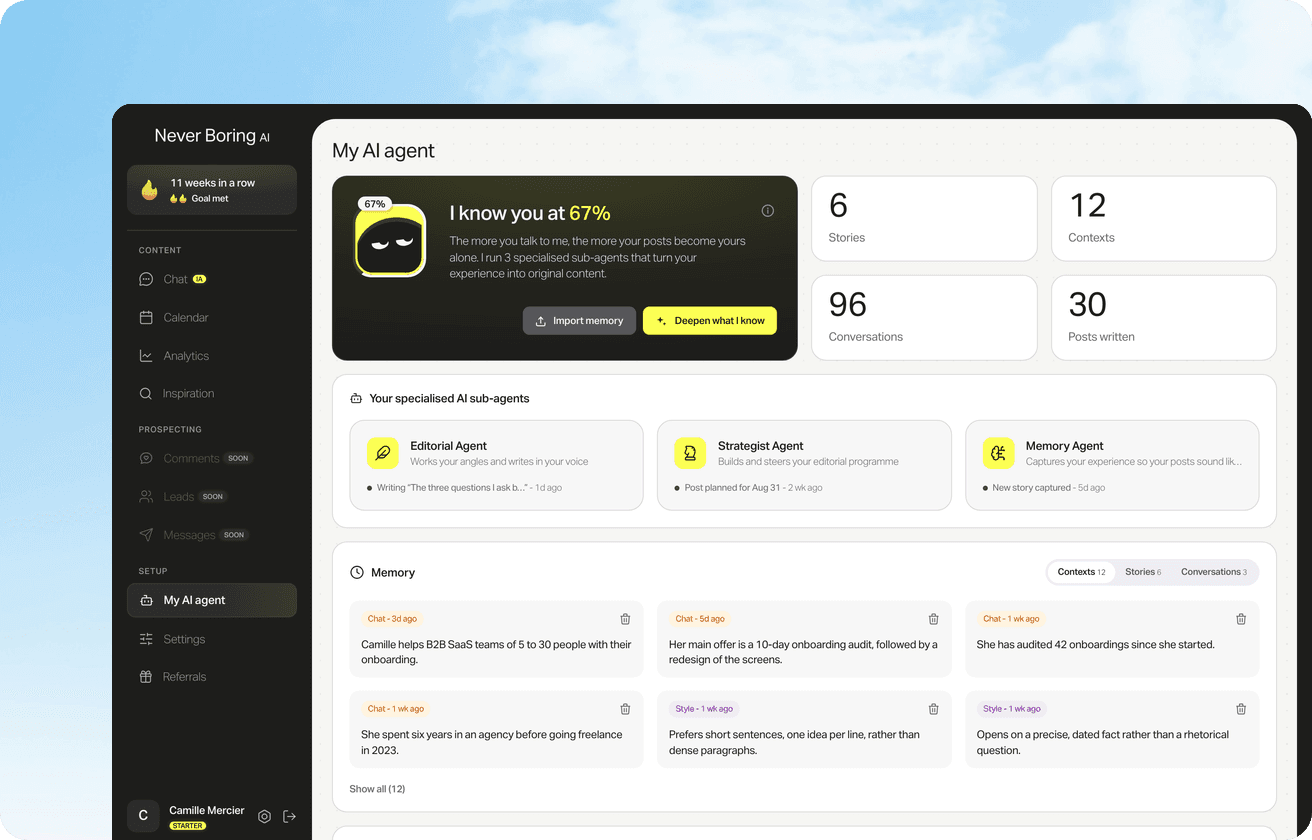
Create your account, no credit card needed, and walk away with your first post in minutes. Your LinkedIn calendar then runs on its own.


Already used by
237 founders