LinkedIn hook: how to write your first line
The LinkedIn hook is the only line visible before the "see more" button. If it doesn't hold attention, the rest of the post never gets read. Here's what the real numbers show from 1,076 posts tracked on their impressions and reactions (Never Boring AI internal data, September 2026), and how to write it from your own experience.
What a LinkedIn hook is
A LinkedIn hook is the first line of a post, the only one visible in the feed without clicking "see more". It's the entry point of your content. On mobile, LinkedIn shows roughly 125 to 140 characters before cutting off. Beyond that threshold, the reader sees nothing: they decide in a fraction of a second whether it's worth continuing. A strong hook isn't a mysterious sentence. It's a precise, true sentence that makes someone want to know what comes next.
What the data shows on length
In the 1,076 posts tracked on their impressions (Never Boring AI internal data, September 2026), short and medium-length first lines perform similarly, while very long ones fall off sharply. First lines of 31 to 60 characters average 4,641 impressions. Very short lines (30 characters or fewer): 4,568. First lines over 100 characters: 2,870 impressions on average, 38% less. The takeaway: a long first line fills the screen and signals a dense post before the reader has even started. A line under 60 characters leaves space and invites reading.
The types of hooks that work
The data shows a clear gap depending on the hook format. Questions average 2,562 impressions, compared to 4,380 for hooks containing a number, and 4,534 for other types (statements, lived experience, concrete situations). A question-as-hook is often too generic. "Do you want to earn more as a freelancer?" says nothing the reader doesn't already know. A statement that takes a position, a specific situation, or a number grounded in real experience holds attention better. Here are the formats that appear most often in the highest-impression posts in the dataset: - The concrete number: an amount, a duration, a count. "1,000 euros. That's what I almost lost." A number creates immediate anticipation. - The specific situation: anchored in a real moment. "Last week, I was celebrating my 26th birthday." Specific, true, human. - The reversal: a statement that contradicts a common belief. "AI tells you what you want to hear." Short and direct. - The quote or unusual detail: "A handshake..." The reader wants to know what follows because the sentence feels incomplete. These formats share one thing: they start from real experience. Not from a generic tip, not from a vague observation.
How to build your hook from what you've experienced
The right hook doesn't come from a topic. It comes from a specific moment. Before writing a single line, answer these three questions: 1. What actually happened? Not a summary: a moment, an exchange, a decision. 2. What detail in that moment would be surprising or counterintuitive to an outsider? 3. Can I phrase it in 60 characters or fewer? If the answer to the third question is yes, you have your hook. If not, you're still talking about a topic, not an experience. Concrete example: you want to write about time management. The topic is "how to manage your schedule". The experience is "this morning I pushed back a meeting and recovered two hours". The hook starts from the experience, not the topic.
The most common mistakes
Several patterns appear repeatedly in hooks that don't get impressions. The empty rhetorical question: "Do you want to succeed on LinkedIn?" This sentence says nothing to anyone because it says nothing about you or your situation. Announcing the plan: "In this post, I'm going to talk about..." You're describing what you're about to say instead of saying it. The reader has no reason to continue. The generic tip: "The key to success is consistency." A statement everyone has already read, with no anchor in any particular experience. The visible engagement request: ending the first line with "Save this post" or "Tell me what you think" before you've said anything. It reads as noise. Excessive length: a 120-character first line that summarizes the entire post. The reader feels they've already seen everything. There's no reason to scroll.
Write hooks from your real experiences
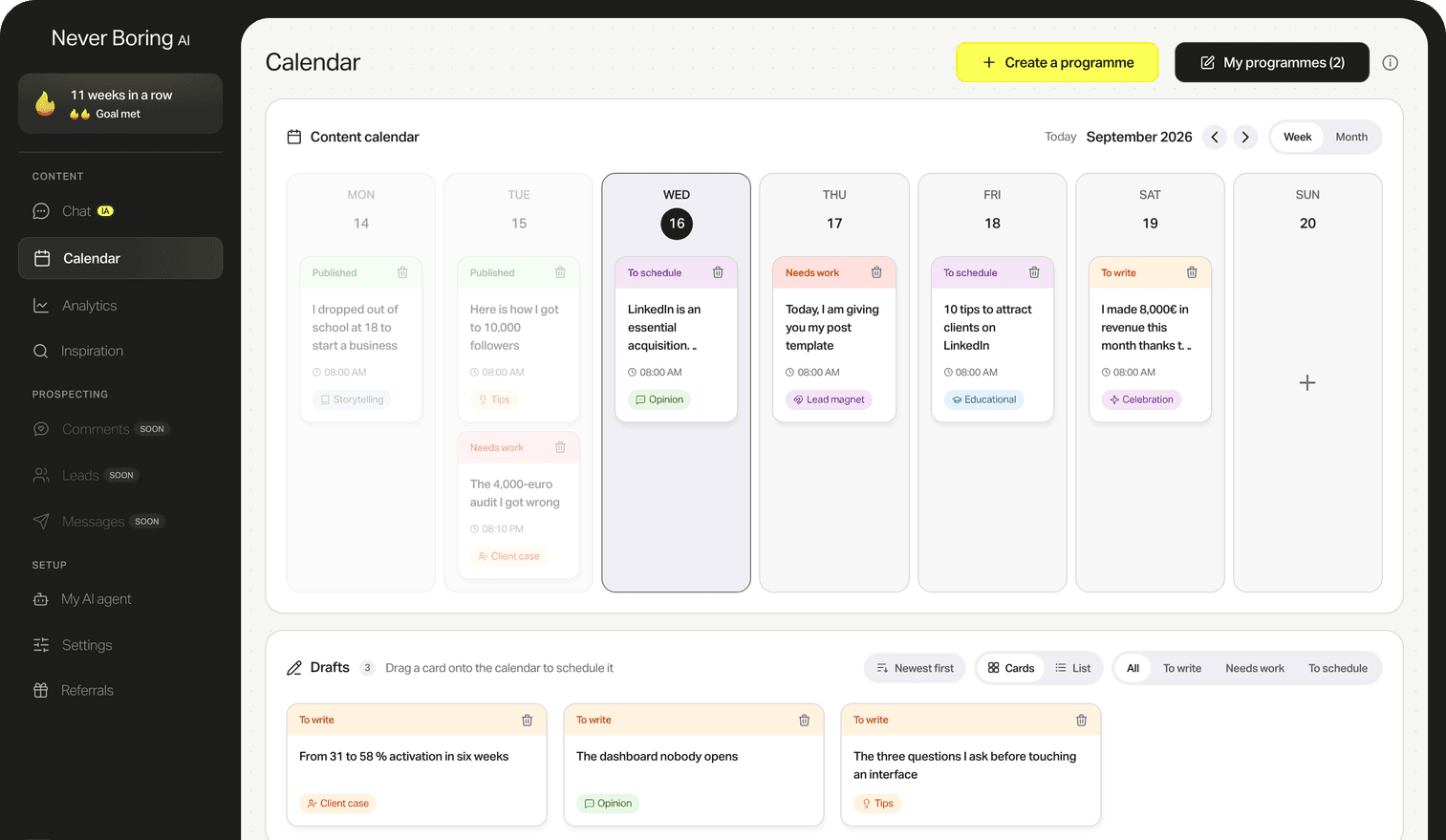
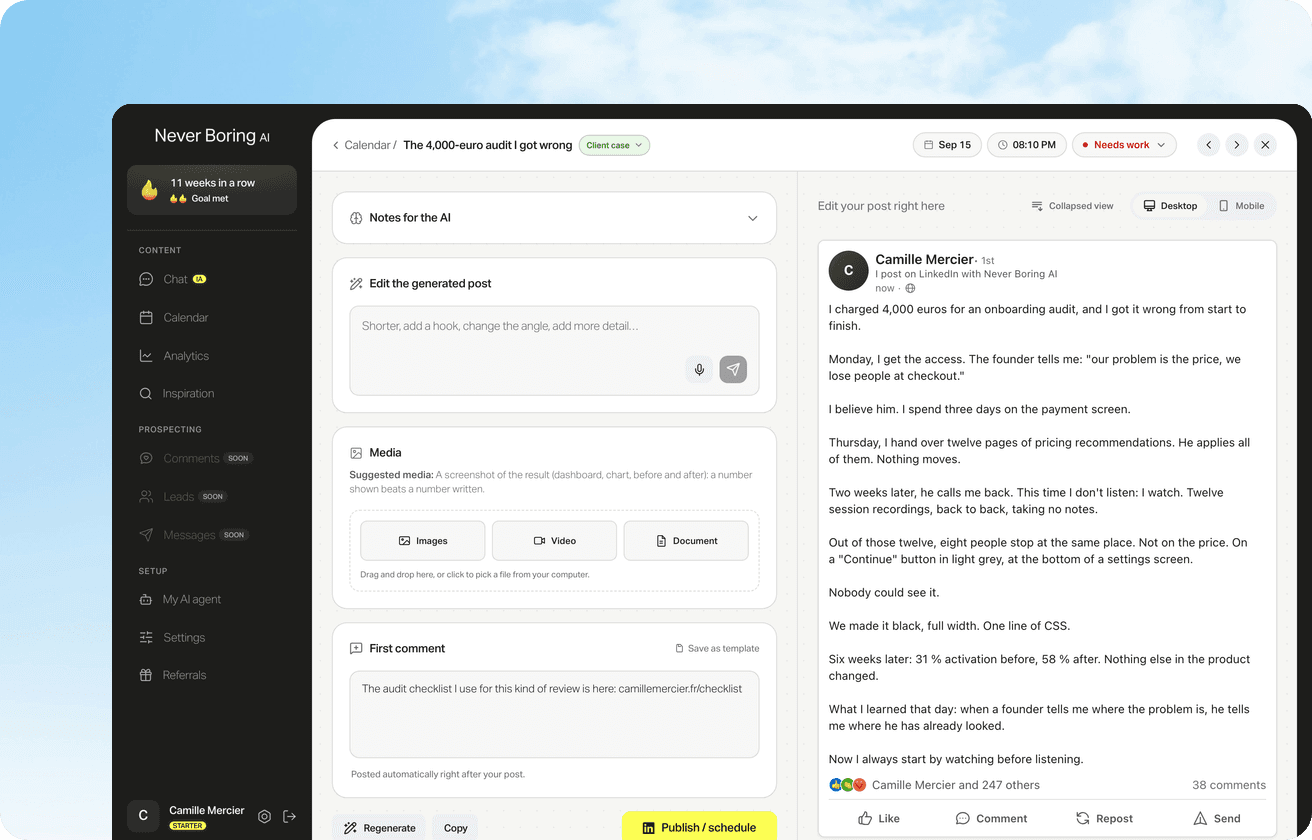
Never Boring AI starts from what you tell it: a moment, a result, a decision. It drafts a post in your voice, with a hook built from your own experience.
What an AI tool can do for your hook
An AI generator easily produces smooth, correct hooks. The problem: they look like every other smooth, correct hook. What changes when the tool starts from your experience: it doesn't invent a generic situation, it reformulates something you told it. The specificity comes from the material, not the model. Before generating a hook, give the tool a real fact: a date, an amount, an exchange. If you give it a vague topic, you'll get a vague hook. If you give it a specific moment, it can extract the line that holds attention.
In summary
The LinkedIn hook is the line that decides whether your post gets read. Data from 1,076 posts tracked on Never Boring AI shows that first lines of 31 to 60 characters average 4,641 impressions, compared to 2,870 for lines over 100 characters. Hooks with a number or a concrete situation outperform rhetorical questions. The practical rule: start from a real moment, phrase it in under 60 characters, don't summarize the entire post in the first line. If you don't have a specific moment to share, you don't have your hook yet.
Data from 1,076 posts tracked on Never Boring AI (September 2026) shows that first lines of 31 to 60 characters average 4,641 impressions. Lines over 100 characters drop to 2,870 impressions on average. In practice, aim for a first line of 40 to 60 characters: specific enough to hold attention, short enough not to cut before the meaning lands.
Read next
50% off your first month
Create your account and walk away with your first post in minutes. Your LinkedIn calendar then runs on its own.


Already used by
202 founders