LinkedIn statistics 2026: users, revenue and real posts
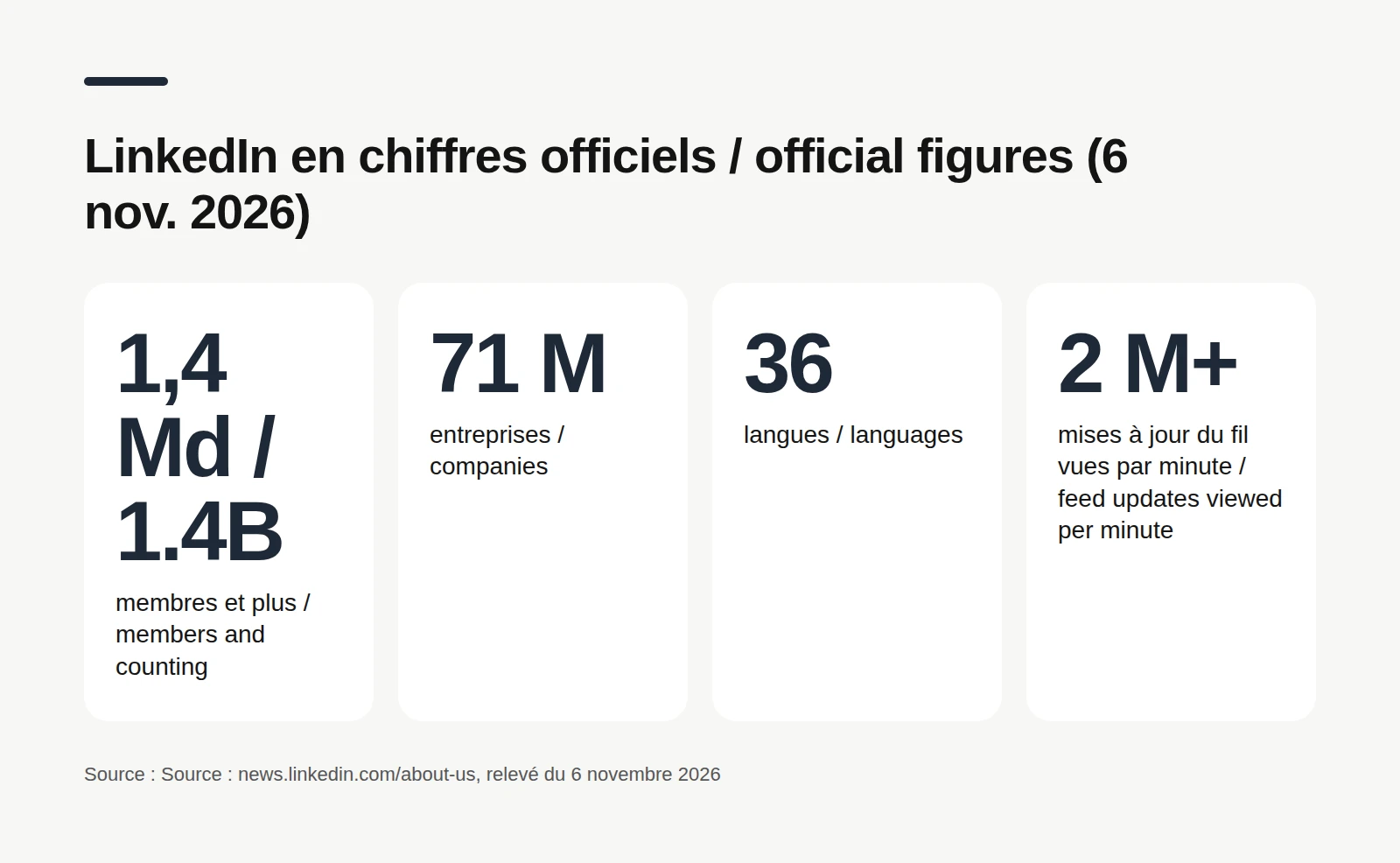
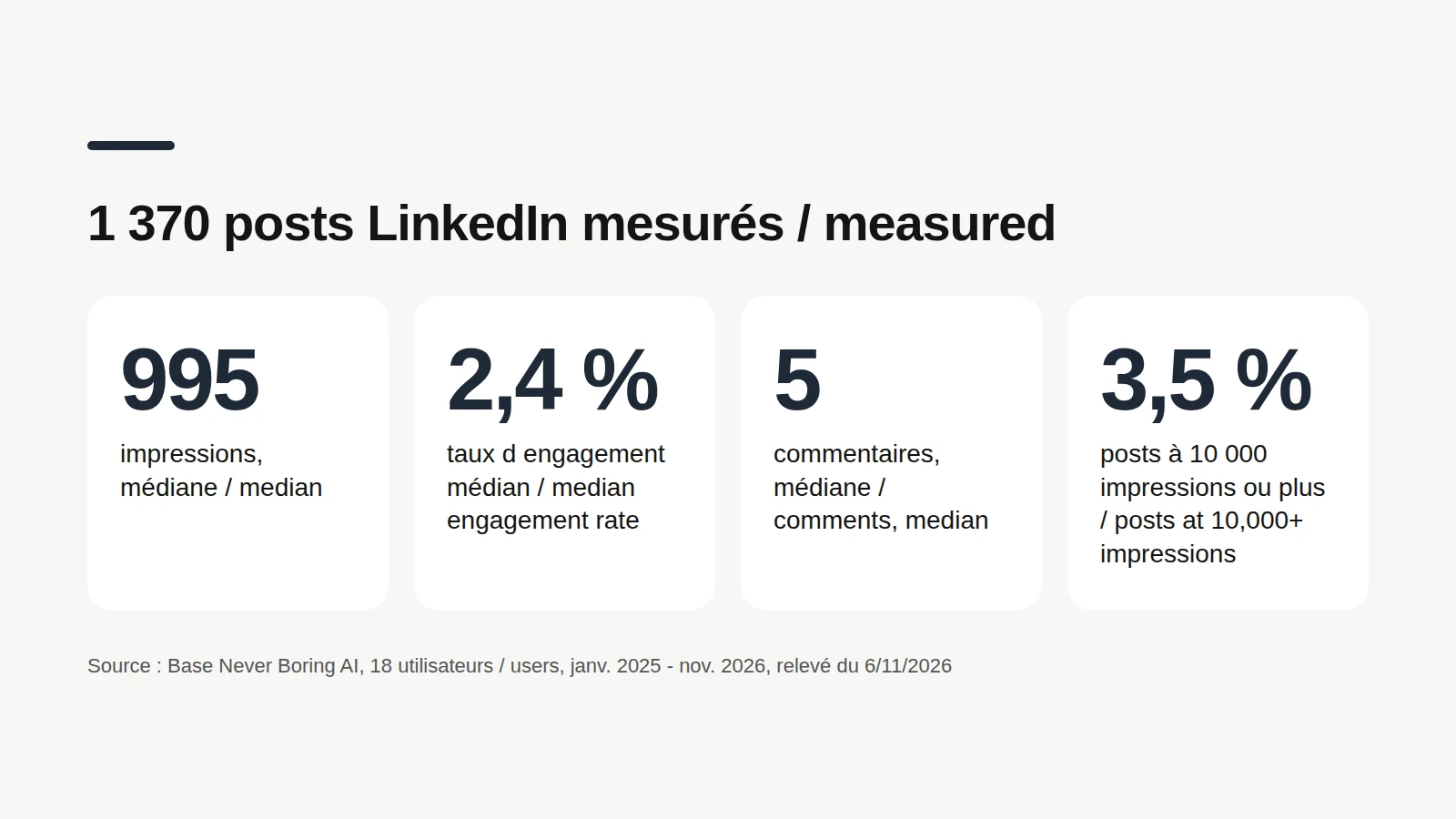
LinkedIn has more than 1.4 billion members and 71 million companies, according to its official statistics page, checked on November 6, 2026. North America alone accounts for more than 296 million members. And on the posting side, the median post among 1,370 posts measured in Never Boring AI's database got 995 impressions. The official numbers tell you how big the room is. Ours tell you how many people actually listen when you grab the mic 🎤.
📊 LinkedIn statistics: what the numbers cover
LinkedIn statistics cover two families of numbers that have little in common. On one side, platform numbers: members, companies, revenue, published by LinkedIn itself. On the other, post numbers: views, reactions, comments, which every member sees in their own analytics. Plenty of "LinkedIn statistics" roundups blend the two, and some of the pages ranking on Google today still lead with figures from 2021 or 2023. Here, every number comes with its source and date. Platform figures come from LinkedIn's official pages, checked on November 6, 2026. Post figures come from two Never Boring AI datasets, with their method and their limits spelled out, because a stat without a method is just a horoscope with decimals.
Your LinkedIn numbers, post by post
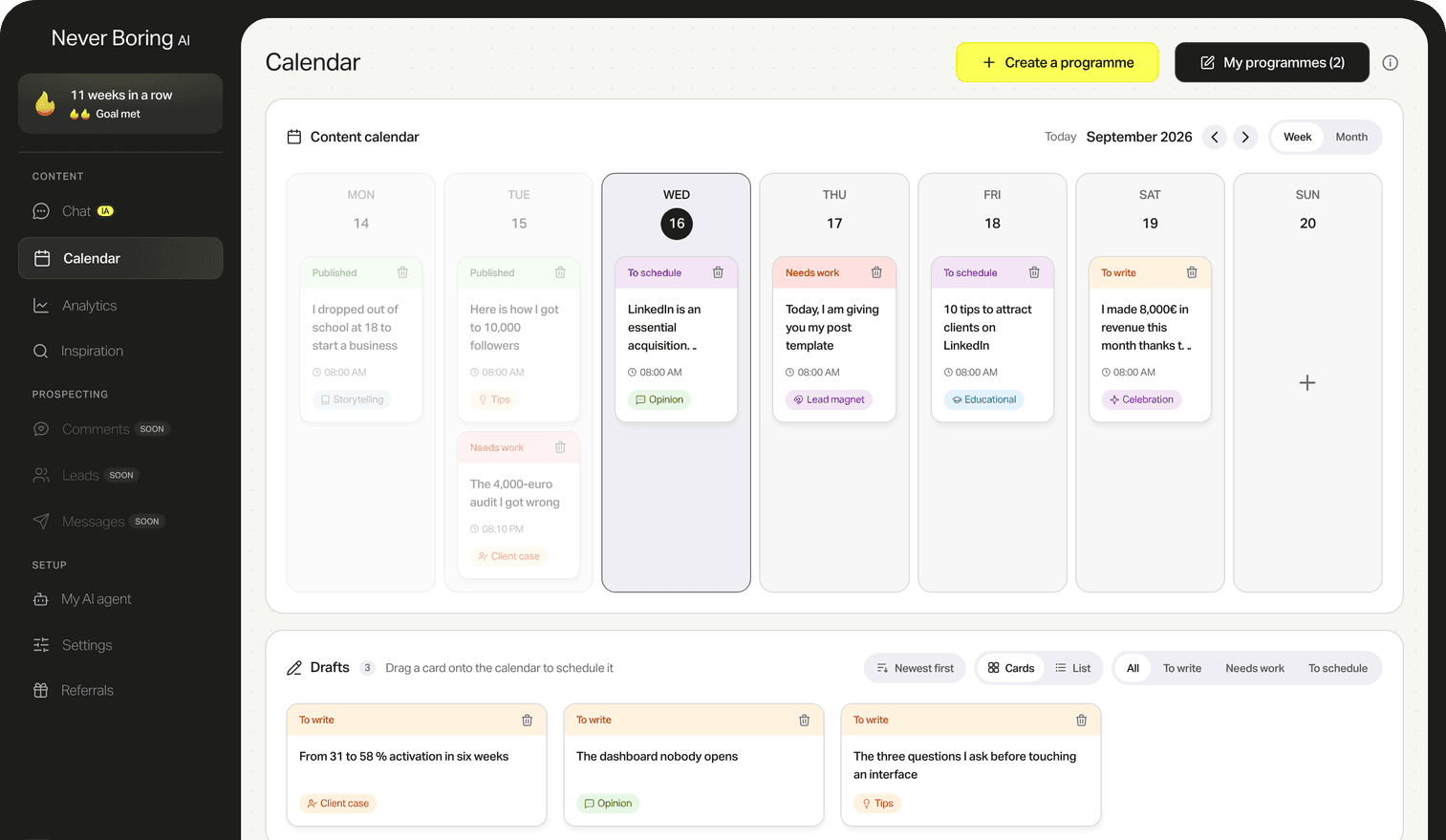
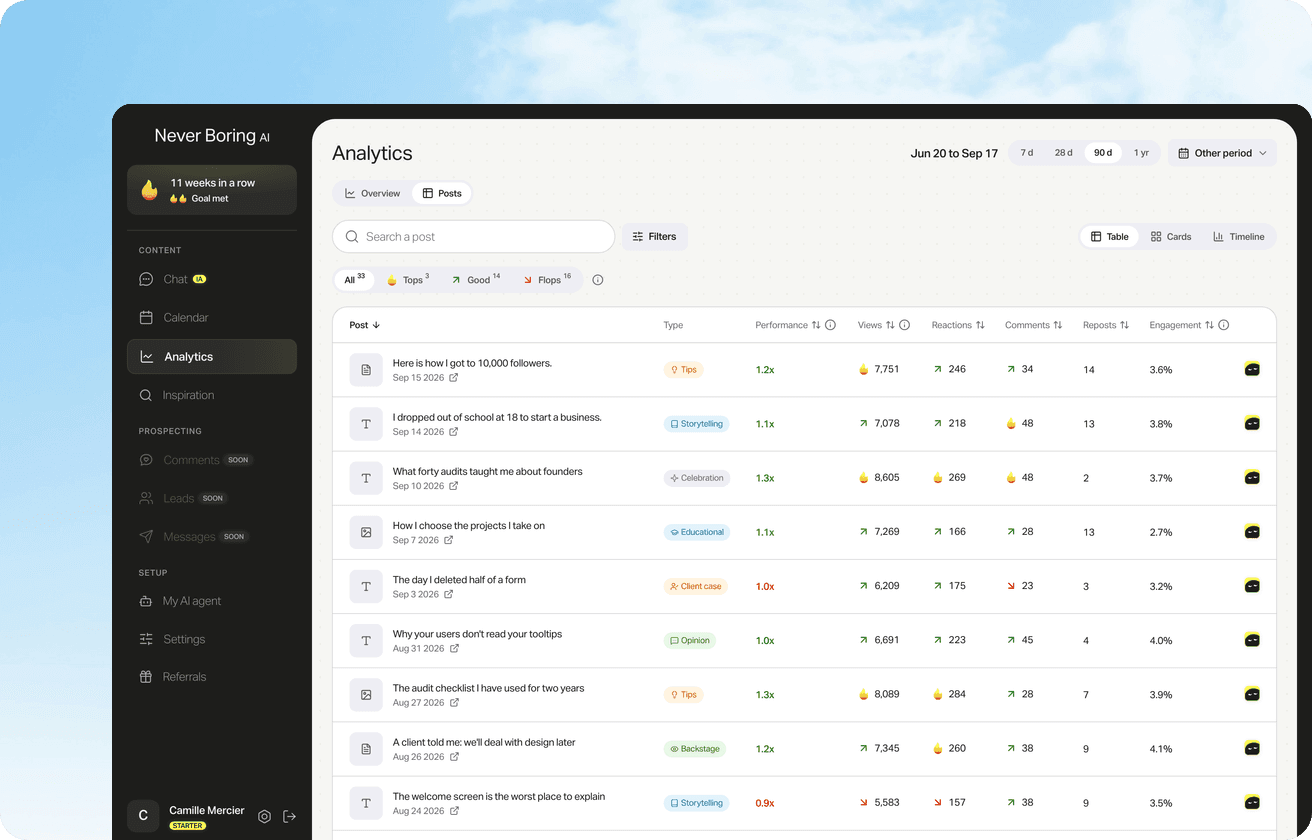
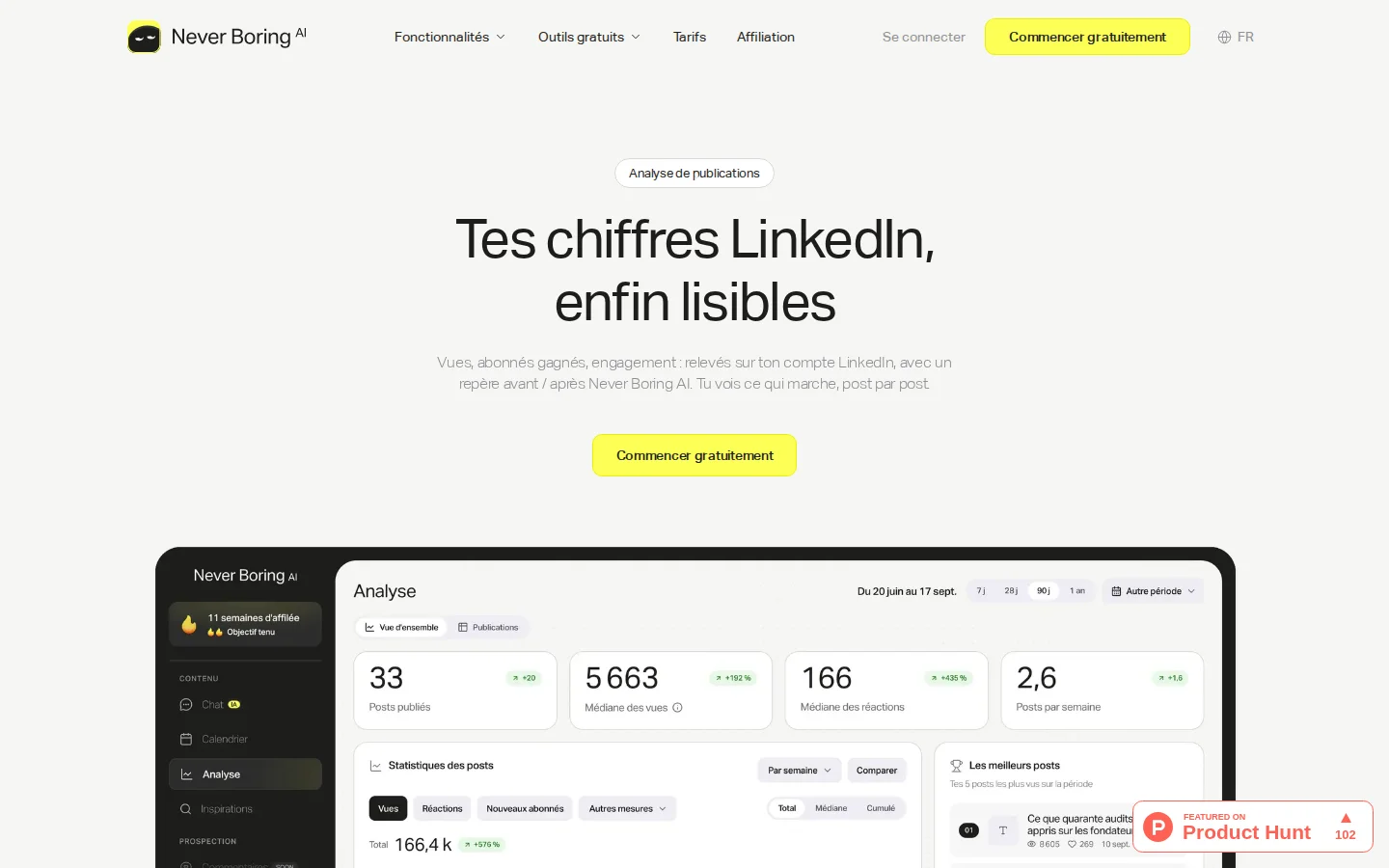
Never Boring AI's LinkedIn post analytics pulls the views, reactions and comments of every post from your account, connected once, and compares each period with the previous one.
How many users does LinkedIn have?
LinkedIn's user count means registered members, not the number of people who log in every day. On its official statistics page, checked on November 6, 2026, LinkedIn reports more than 1.4 billion members. The same page breaks them down by region: Europe, Middle East and Africa: 450 million+ Asia Pacific: 427 million+ North America (United States and Canada): 296 million+ South and Central America: 233 million+ A fun detail for anyone who likes checking sources 🔍: on the same day, LinkedIn's English "About" page still said "more than 1 billion members", and its French version said "more than 850 million users". Three official pages, three numbers. If you quote LinkedIn's member count in a deck, cite the statistics page in LinkedIn's newsroom, along with the date you read it. One more thing: a member is not an active user. That page gives no daily or monthly active user count. Any active-user figure you see comes from somewhere else, so check where before you repeat it.
🇺🇸 LinkedIn in the US and North America
LinkedIn in the US means the member base LinkedIn counts in its North America region, and that's as precise as the official statistics page gets. As of November 6, 2026, it reports more than 296 million members in North America, a region it defines as the United States and Canada. There is no US-only figure on that page. The US is also where most of LinkedIn's offices are. The same page lists US offices in Bellevue, Carpinteria, Chicago, Detroit, Mountain View, New York, Omaha, San Francisco, Sunnyvale and Washington, DC, out of more than 36 cities worldwide. You'll find US-only numbers elsewhere: share of adults on LinkedIn, income brackets, time spent per day. Some come from solid surveys, others get copied from post to post with no date. Before you drop one in a pitch, trace it back to its original source and year. A stat without a source is just a rumor with a decimal point.
🏢 LinkedIn company statistics: owner, revenue, team
LinkedIn is also a company, owned by Microsoft since 2016. Microsoft announced the deal on June 13, 2016, at $26.2 billion, according to the press release LinkedIn published, and closed it on December 8, 2016. The release said LinkedIn would keep its distinct brand, culture and independence. Reid Hoffman, co-founder, was chairman of the board at the time. Here's what LinkedIn's official statistics page says, as of November 6, 2026: about 20 billion in annual revenue (the page doesn't state the currency) 5+ years of double-digit member growth 16% year-over-year growth in content views 25% year-over-year growth in paid video ads 15,500+ full-time employees 36 languages 71 million companies, 145,000+ schools and 42,000+ skills listed The number that matters most to a creator is that 16% jump in content views. More views overall doesn't mean more views for you: it means the feed is getting busier, and attention gets earned one post at a time.
⏱️ What happens on LinkedIn every minute
A minute on LinkedIn is how LinkedIn sums up its activity on its statistics page: what happens, on average, every sixty seconds. According to that page, as of November 6, 2026, every minute: 2 million+ feed updates are viewed 19,000+ connections are made about 9,000 job applications are submitted 110 people add a new role to their profile about 119 hours of learning content are consumed The one that matters to a creator is the first. Over 2 million feed updates viewed per minute is huge. It's also, quite literally, the competition for your next post 😅. Which raises the real question: how much of that pie does an ordinary post get?
📈 LinkedIn post statistics: 1,370 measured posts
LinkedIn post views, which LinkedIn calls impressions, are the number of times a post was displayed on screen. To see what an ordinary post gets, we queried Never Boring AI's database on November 6, 2026. The method: 1,370 posts published on LinkedIn by 18 users who connected their account, between January 2, 2025 and November 5, 2026. Team and test accounts excluded, reposts excluded, posts under 50 characters excluded. 15 of those 18 accounts write in French, so read this as a European reference point rather than a US benchmark. What those 1,370 posts show: The median post got 995 impressions, and the middle half sits between 538 and 2,154. So one post in two stays under 1,000 impressions. 7.8% of posts pass 5,000 impressions, and 3.5% reach 10,000 or more. Those 10,000+ posts come from 9 of the 18 accounts. The median post got 21 reactions and 5 comments, and 16% of posts got no comment at all. 58% of posts were never reposted by anyone. The median engagement rate (reactions, comments and reposts divided by impressions) is 2.4%, and the middle half sits between 1.5% and 3.4%.
On formats, nearly 7 posts in 10 in this dataset include an image, 13% are text only, 11% are videos and 6% are documents. And on timing, these accounts post almost only on weekdays: just 36 of the 1,370 posts went out on a Saturday or Sunday. These numbers describe those 18 accounts, not LinkedIn as a whole. They're Never Boring AI users, meaning people who post with a writing tool. With so few accounts, one very active author can weigh a lot, and nothing here explains why one post got more views than another. That's also why we report medians, not averages: a single 50,000-view post is enough to inflate an average, while the median stays the post in the middle.
Calculate your LinkedIn engagement rate
Free tool, no email needed: enter a post's numbers and it works out the engagement rate. Handy for comparing yourself with the reference points above, using the same formula.
Impressions, members reached, views: the full picture
What each number counts, where to find yours, and what a good number looks like based on 1,376 Never Boring AI posts.
✍️ What a LinkedIn post looks like: 1,525 French-language posts
A LinkedIn post's format is its length, its layout and the way it hooks, and that's where a second dataset helps. The Never Boring AI corpus holds 1,525 real, anonymized French-language LinkedIn posts, written by 45 authors between March 20, 2025 and October 31, 2026. French posts, yes, but layout habits travel well. Length: 1,257 characters at the median, and the middle half runs from 870 to 1,705 characters. Long enough to tell a story, too short for a novel. Layout: 6 lines at the median, but at least a quarter of posts are a single block with no line break, while the airiest quarter runs to 16 lines or more. Emojis: one per post at the median, and 42% of posts have none. Questions: 51% of posts contain at least one question. Call to action: 27% of posts include one. Hooks, sorted by type: opens with a number: 50% bold statement: 26% contrarian take: 14% anecdote: 5% question: 3% And post formats: storytelling (51%), build in public, meaning sharing your work behind the scenes (25%), lists (15%), opinion (4%) and advice (3%). The corpus's median post got 39 reactions and 11 comments.
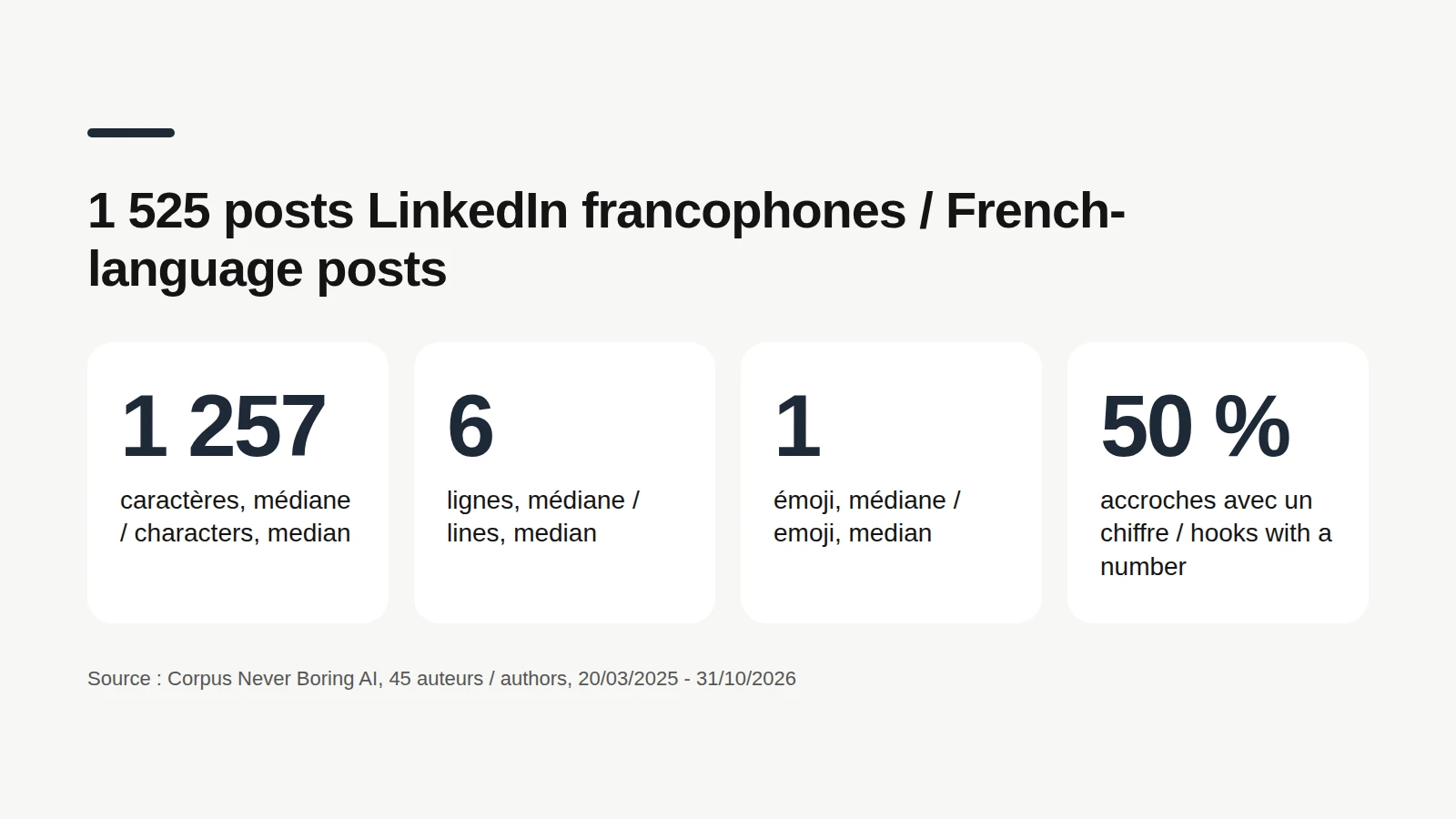
One fun contrast: more than half of the posts contain a question, but barely 3% open with one. In this corpus, the question almost always shows up further down the post, and the first line leads with a number or a sharp statement instead. These numbers describe what these 45 French-speaking authors publish, not what works. A hook with a number isn't "better" because it's common: nobody tested the same post with two different hooks. Read them as a snapshot of what people do, not as a recipe.
Length, line breaks, first line
Everything that makes up a LinkedIn post's format, from the "… more" cut to line breaks, with the corpus reference points.
🔎 How to get your own LinkedIn stats
Your LinkedIn stats are the numbers LinkedIn gives you for free on your posts and your audience. According to LinkedIn's help center, on desktop: click the Me icon at the top of your homepage, then View Profile, scroll down to the Analytics section and click Show all. You'll find content analytics (your posts over time) and audience analytics (your followers). The Export button downloads it all as an .XLSX file. Two details change how you read them, again according to LinkedIn's help center. Your own views and reactions count toward your numbers. And the numbers don't last forever: a post's impressions and engagements stay available for 1,000 days, members reached for 400 days, demographics for 180 days. For a single post, go to Posts & Activity and click the impressions count under the post. To compare yourself with the reference points in this article, keep the same formula: a post's reactions, comments and reposts, divided by its impressions, times 100. And compare yourself with yourself first, over several weeks.
The LinkedIn analytics guide
Impressions, members reached, engagements: what each LinkedIn number means, and 6 tools to go further, compared with their prices.
What LinkedIn statistics don't tell you
The limits of LinkedIn statistics are everything a number, even an official one, leaves out. Four traps come up again and again. A member isn't a reader. 1.4 billion members doesn't mean 1.4 billion people reading the feed every day. An impression isn't a read. According to LinkedIn's help center, an impression counts a display on screen, and it's an estimate. A thumb scrolling past counts the same as a hooked reader. An average hides the extremes. One viral post drags everything up: that's why the medians in this article are lower than the "averages" you'll read elsewhere. Every number has a date. The same network showed 850 million, 1 billion and 1.4 billion members on three of its own pages, on the same day.

The hook is where it all happens
Half the hooks in the corpus open with a number. Other ways to write a LinkedIn first line that makes people click "… more", with examples.
Bottom line: the LinkedIn statistics worth remembering
On the platform side, per LinkedIn's official page checked on November 6, 2026: more than 1.4 billion members, more than 296 million in North America, 71 million companies, over 2 million feed updates viewed every minute, and a Microsoft subsidiary since 2016. On the posting side, across 1,370 measured posts: 995 impressions and a 2.4% engagement rate for the median post. The number that really counts is your own, tracked over time. To post consistently without giving up your evenings, Never Boring AI's AI LinkedIn post generator builds your posting plan, drafts your posts in your voice and keeps your stats right next to them.
Posts in your voice, with their numbers alongside
Never Boring AI's AI LinkedIn post generator starts from your business, writes in your voice and schedules your posts. Free trial.
Your first posting plan, on us
Tell the agent about your business: it builds your posting plan, drafts your posts in your voice and publishes them on LinkedIn.
What questions come up most often?
The questions that keep coming up on this topic, and how we answer them.
More than 1.4 billion members, according to LinkedIn's official statistics page, checked on November 6, 2026. That counts registered members, not people active every day, which the page doesn't report. By region, Europe, the Middle East and Africa account for more than 450 million, Asia Pacific for more than 427 million and North America for more than 296 million.
Read next
Your first content plan and your first 3 posts are on us
Create your account, no credit card needed, and walk away with your first post in minutes. Your LinkedIn calendar then runs on its own.


Already used by
249 founders